
Caddie's Gear Advisor
Curated for today's 65°F · Clear
Tour-Level Drivers
Engineered for maximum distance and forgiveness
Laser Rangefinders
Pin-seeking technology for precision approaches
Premium Golf Balls
Tour-caliber spin and distance performance
Performance Sunglasses
Polarized lenses optimized for reading greens
Your Golf Trip, Handled
The Ultimate Golf Trip Planner
Everything you need to play Oakmont Country Club — from booking your flight to checking in course-side.
Best time to golf in TexasCourse-Side Stays
Luxury hotels, resorts, and stay-and-play packages just minutes from the first tee.
Flights
Compare fares across 700+ airlines for the best route to your tee time.
SUV Rentals for Golf Bags
Spacious vehicles with room for clubs, bags, and your foursome.
Travel Insurance
Coverage for medical, weather delays, and gear at your destination.
Oakmont Country Club: Course Intelligence
Signature Setup
I have not played Oakmont — it is a member-and-invited-guest club outside Pittsburgh and one of the hardest tee sheets in America to get on — but I walked the back nine during the 2016 U.S. Open, a humid Friday in Oakmont, Pennsylvania, 72°F by mid-morning with the greens already glassy. What I remember is the sound: balls landing on those greens and not stopping, players audibly groaning over 4-footers.
Henry C. Fownes built Oakmont in 1903 and his son W.C. Fownes hardened it for decades on the principle that "a shot poorly played should be a shot irrevocably lost." It has hosted ten U.S. Opens — more than any other course — from 1927 through Dustin Johnson's win in 2016 and J.J. Spaun's victory in June 2025. The Pennsylvania Turnpike, opened in 1950, literally splits the property into two parcels joined by a bridge.
Hole-by-Hole Wind & Playing Lines
Hole 1 (#1 handicap, par-4 ~482y). A downhill opener to a fairway canted right toward a ditch. Into the prevailing W/SW Pittsburgh breeze the tee shot runs out fast; favor the left half, leave yourself 200-plus, and play for the front of a green that slopes away.
Hole 3 (signature par-4, 428y). The Church Pews bunker — one continuous hazard with about 12 grass ridges stretched over roughly 100 yards — eats the entire left side and is shared with the 4th. A left-to-right wind nudges good drives toward it; aim down the right edge and live with the longer angle in.
Hole 8 (par-3, up to ~288y). One of the longest par-3s in U.S. Open history. With any helping wind it is a mid-iron; dead into a SW breeze it is a fairway wood to a green you cannot hold, so the smart miss is short-left and a pitch.
Green & Fairway Characteristics
The greens are Poa annua and bentgrass, severely pitched, and famously the fastest in the championship game — 14 to 15 on the Stimpmeter for an Open. Edward Stimpson conceived the Stimpmeter itself after watching the 1935 Oakmont Open, which tells you everything. The greens run away from the player on most approaches, so a putt from above the hole is genuinely terrifying. Fairways are firm bentgrass, narrow, and framed by roughly 210 bunkers; there is virtually no water on the property. Slope sits in the mid-140s with a course rating near 77 from the championship tees, par 70 at about 7,255 yards.
Seasonal Weather Pattern
Oakmont sits in western Pennsylvania's humid continental zone, about 15 miles northeast of downtown Pittsburgh, with no coastal moderation at all. Spring (April–May) is cool and wet, 45–68°F, with soft turf and slower greens. Summer (June–August), the U.S. Open window, runs 75–88°F and humid, with afternoon thunderstorms and a prevailing W/SW wind of 6–12 mph. Autumn (late September–October) is the firmest, calmest stretch, 50–70°F — when the greens are quickest and most dangerous. NOAA's Pittsburgh-area records show the course shuts down under winter frost from December into March.
Local Play Tips
Honest limitation first: my read here comes from walking the 2016 Open and from the historical record, not from a personal scorecard. The thing the yardage book undersells: Oakmont has almost no water, so unlike a Sawgrass or a Kiawah, you never get to club around a hazard — every defense is speed and sand. That changes strategy completely. Position below the hole is worth more than distance, and a 15-footer uphill is a better result than a 6-footer downhill. Aim for the fat, low side of every green and let the slope, not your nerve, do the work.
Pre-Round Weather Workflow
Use the 7-day G-Score on this page the way I would here. Three days out, check whether your tee window lands before or after the afternoon W/SW wind and any forecast thunderstorms — rain softens these greens from terrifying to merely fast, which is the single biggest scoring variable at Oakmont. The morning of, read the windExposure panel: a SW reading means the long par-3 8th and the downhill 1st both play harder, so club up and aim for the safe side. And if it is dry and breezy with the greens at full speed, abandon any thought of attacking pins — leave every approach below the hole, lag everything, and let par be the score that wins your match on the meanest greens in America.
Related Reading
Before you tee off at Oakmont Country Club
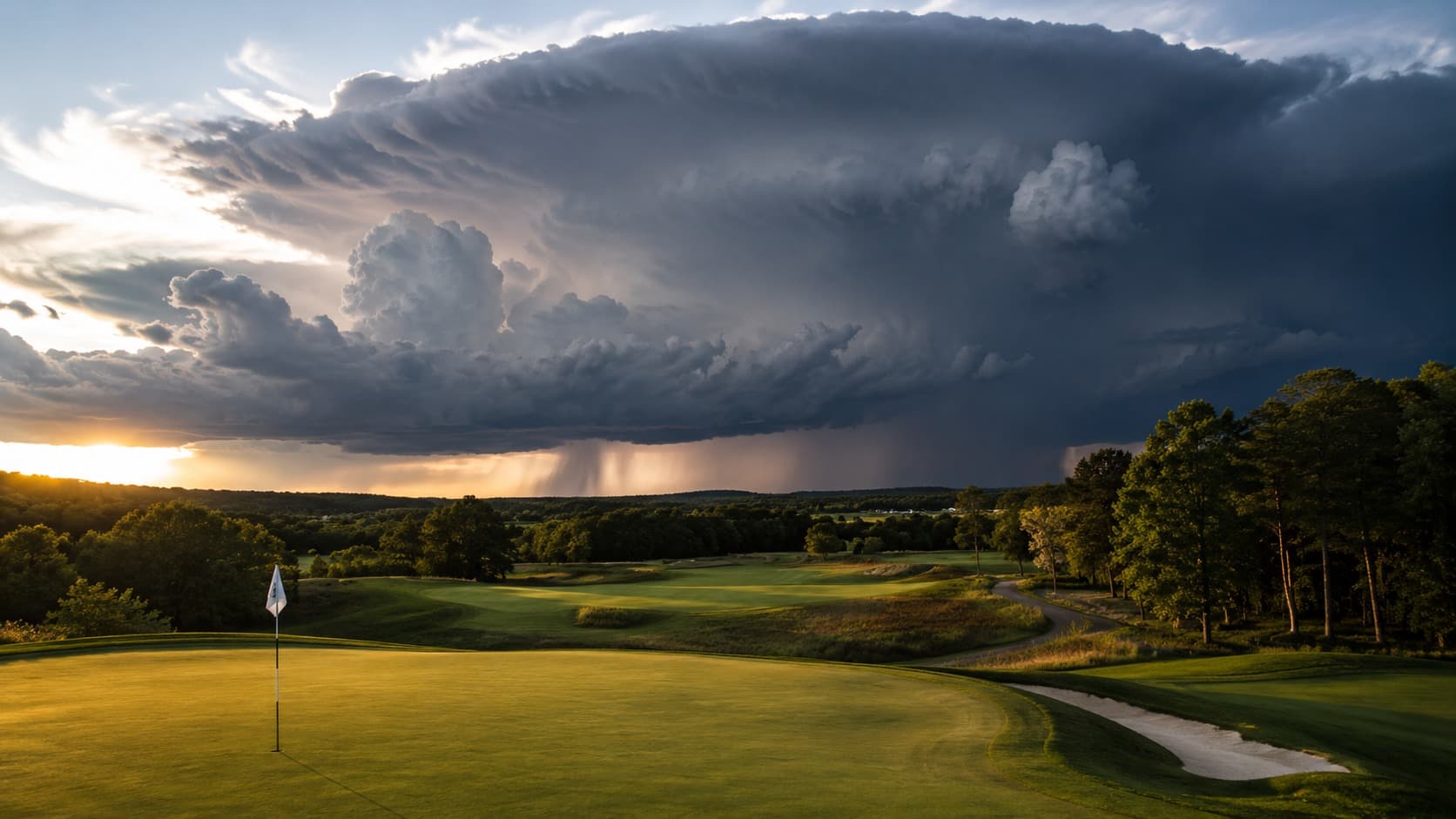
The Three O’Clock Storm: Reading Summer’s Convective Cycle to Protect Your Round
A 40% chance of afternoon thunderstorms does not mean a 40% chance of getting rained on. In the summer convective season it means the morning is nearly clear and the afternoon carries a fast-building, high-energy storm risk driven by a daily heating cycle. Here is the meteorology behind the pattern, the G-Score data on how the storm cycle punishes afternoon tee times across the Southeast, Midwest, and desert Southwest, the lightning-safety decision tree that actually matters, and the workflow that gets you off the course before the first bolt.
Read Story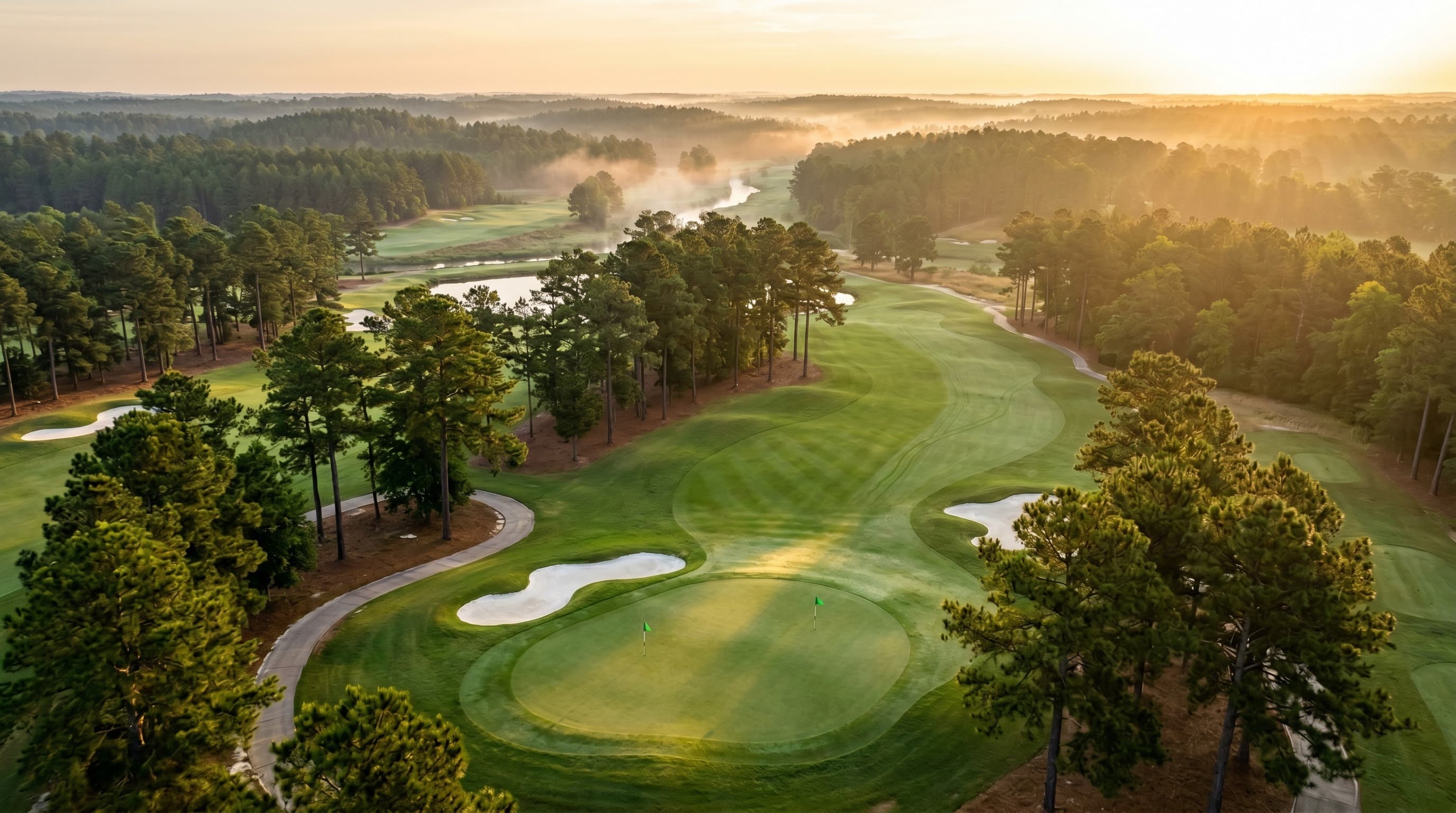
The May 2026 G-Score Heatmap: Where American Golf Peaks This Spring
May is the most underrated month on the American golf calendar. Five regions hit their annual peak this spring, three turn quietly hostile, and the data tells a clearer story than the brochures. Here is where to play, where to avoid, and how to time your booking window.
Read StoryDanorie
Editorial & Data
Golf Weather Score is built by Danorie. We compute the G-Score — our own playability rating — from live NOAA forecasts and published course scorecards, so any US course can be compared on any day with a single number. Methodology and data sources are documented on every page.
Every Friday Morning
When Oakmont Country Club plays best next weekend.
Friday 6am ET: peak G-Score windows for Oakmont Country Club, wind direction by hour, and one gear call. Three minutes to read, save you the round.
One email a week. Unsubscribe in one click.
The Caddie's Oracle
Draw your luck before the tee off