
Caddie's Gear Advisor
Curated for today's 61°F · Clouds
Tour-Level Drivers
Engineered for maximum distance and forgiveness
Laser Rangefinders
Pin-seeking technology for precision approaches
Premium Golf Balls
Tour-caliber spin and distance performance
Performance Sunglasses
Polarized lenses optimized for reading greens
Pine Needles: Course Intelligence
Donald Ross designed Pine Needles in Southern Pines, North Carolina in 1928, on a piece of Sandhills land directly across the road from his earlier Mid Pines course. The Peggy Kirk Bell family owned the resort for most of the second half of the twentieth century — Bell herself was an LPGA founder and a teaching legend whose name is still on the Peggy Kirk Bell Award given annually to the LPGA Tour's contributions-to-the-game honoree. Pine Needles has hosted the U.S. Women's Open four times: Annika Sorenstam won in 1996, Karrie Webb in 2001, Cristie Kerr in 2007, and Minjee Lee in 2022. Kyle Phillips restored the Ross routing in 2018 ahead of the 2022 championship.
The scorecard reads 6,917 yards from the back markers, par 71, with a slope of 134 and a course rating of 73.5. The four par-3s sit between 145 and 209 yards. The 209-yard fifth is the longest one-shotter on the routing and plays uphill into prevailing southwest wind; the 145-yard third is the shortest and plays to a green Ross crowned aggressively against a back-edge fall-off. The three par-5s — 500, 521, and 523 yards — are scoring chances by modern standards but were designed as full three-shotters in the wound-ball era.
The number-one handicap is the 450-yard fourth — a long par-4 with an approach into a green that Ross set behind cross-bunkers. The 439-yard second-hardest is the par-4 ninth that closes the front; the 445-yard third-hardest is the par-4 thirteenth. Three of the top-three are par-4s over 430 yards, which is the slope signal that Ross used the lineup of long two-shotters to defend the course's rating rather than back-tee length.
The Sandhills climate keeps Pine Needles playable from March through November, with the firmest conditions arriving in October. The native wiregrass and longleaf pine give the property the same visual character as the Pinehurst courses fifteen miles to the north. The resort runs walking caddies during member season; carts are standard for daily-fee guest play.
Related Reading
Before you tee off at Pine Needles

America's 20 Windiest Golf Courses: A G-Score Wind Analysis
We ranked America's 20 windiest golf courses using G-Score wind penalty data. See how coastal gusts and prairie gales reshape playability scores.
Read Story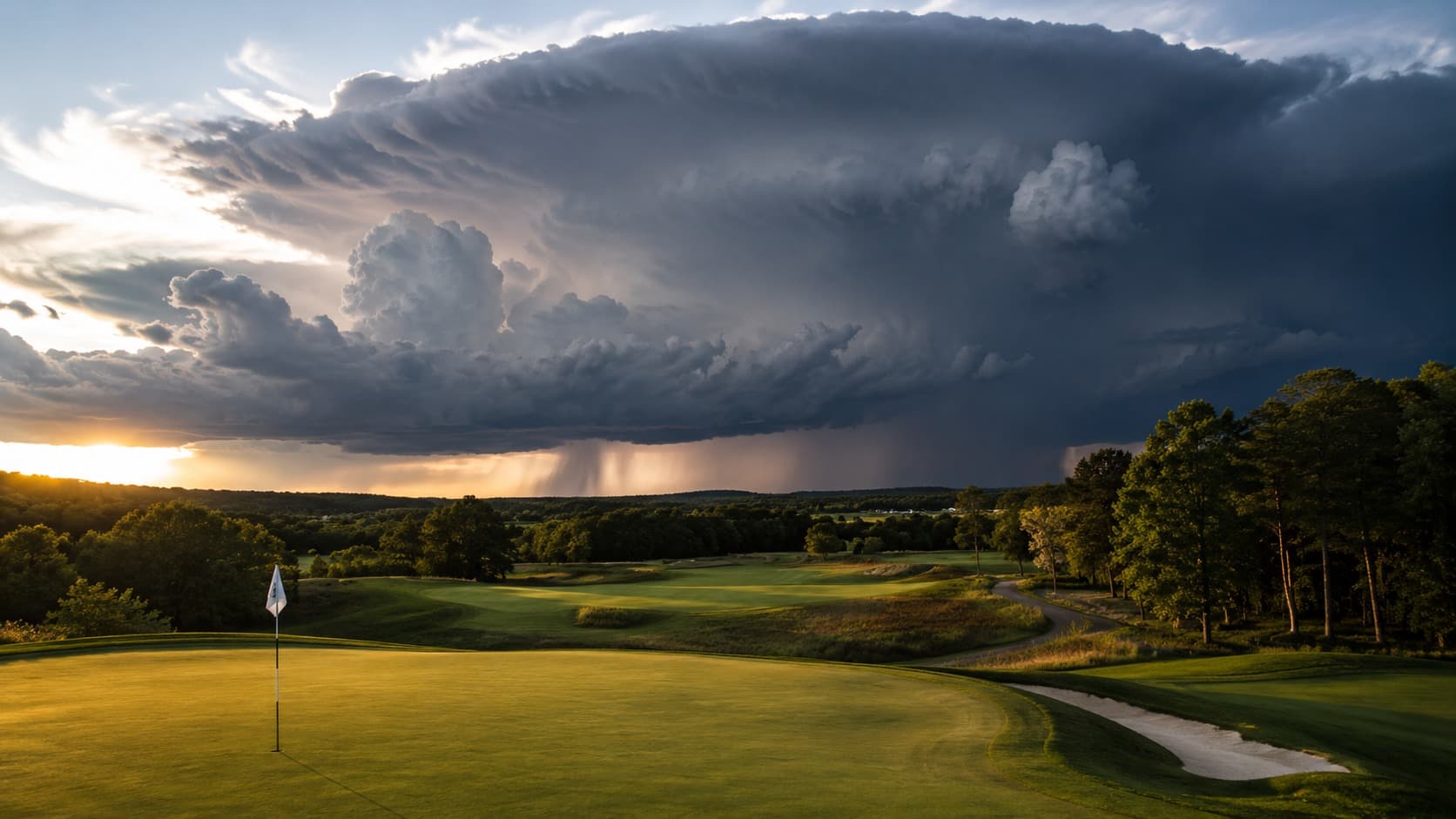
The Three O’Clock Storm: Reading Summer’s Convective Cycle to Protect Your Round
A 40% chance of afternoon thunderstorms does not mean a 40% chance of getting rained on. In the summer convective season it means the morning is nearly clear and the afternoon carries a fast-building, high-energy storm risk driven by a daily heating cycle. Here is the meteorology behind the pattern, the G-Score data on how the storm cycle punishes afternoon tee times across the Southeast, Midwest, and desert Southwest, the lightning-safety decision tree that actually matters, and the workflow that gets you off the course before the first bolt.
Read StoryDanorie
Editorial & Data
Golf Weather Score is built by Danorie. We compute the G-Score — our own playability rating — from live NOAA forecasts and published course scorecards, so any US course can be compared on any day with a single number. Methodology and data sources are documented on every page.
Every Friday Morning
When Pine Needles plays best next weekend.
Friday 6am ET: peak G-Score windows for Pine Needles, wind direction by hour, and one gear call. Three minutes to read, save you the round.
One email a week. Unsubscribe in one click.
The Caddie's Oracle
Draw your luck before the tee off