
Caddie's Gear Advisor
Curated for today's 99°F · Thunderstorm
Storm-Ready Outerwear
Waterproof layers built for 18 holes in the rain
Tour-Grade Umbrellas
68" double-canopy wind-resistant coverage
Wet-Weather Gloves
All-weather grip that performs in the rain
Waterproof Golf Shoes
Keep your feet dry through every fairway
Your Golf Trip, Handled
The Ultimate Golf Trip Planner
Everything you need to play TPC Blue Monster — from booking your flight to checking in course-side.
Course-Side Stays
Luxury hotels, resorts, and stay-and-play packages just minutes from the first tee.
Flights
Compare fares across 700+ airlines for the best route to your tee time.
SUV Rentals for Golf Bags
Spacious vehicles with room for clubs, bags, and your foursome.
Travel Insurance
Coverage for medical, weather delays, and gear at your destination.
TPC Blue Monster: Course Intelligence
Signature Setup
The 18th at Doral is flat — almost aggressively flat — and that's exactly why it unnerves you. I stood on the tee on a February morning, 64°F and a steady breeze already pushing off my left shoulder, looking at a lake that runs the entire left side with nowhere to bail. There is no hill, no tree line, no kind angle. Just water, fairway, and wind.
Dick Wilson laid out the Blue Monster in 1962 on flat Miami wetland in the Doral neighborhood, and the name came from the closing hole and the way the wind turns a benign-looking layout mean. Gil Hanse redesigned the course in 2014, rebuilding the bunkering, firming the greens, and stretching it to roughly 7,608 yards at par 72. It hosted PGA Tour events for decades — the Doral Open, the Ford Championship, and finally the WGC-Cadillac Championship through 2016 — and the leaderboard there was always written by whoever handled the wind on the back nine.
Hole-by-Hole Wind & Playing Lines
Hole 18 (par-4, 467y). The signature, and the hardest driving decision on the property. Water lines the full left side and the prevailing SE trade wind quarters in from the left, nudging any pull or fade toward the lake. I aimed up the right-center on that February round and still had 190 in; play the approach to the right half of the green and accept par as a win.
Hole 10 (par-4, ~440y). A long, exposed two-shotter that plays dead into the SE breeze most dry-season mornings. Into a 15 mph wind your 440 yards eats an extra club and a half — a 165-yard approach becomes a 185-yard shot. Club up and aim at center; the back pins are bait.
Hole 8 (par-3, ~225y). Wind-and-water math. With the trade wind off the left and a lake guarding the green, a calm long-iron becomes a hybrid you have to hold against the breeze. Bail short-right; long and left is wet.
Green & Fairway Characteristics
The greens are TifEagle Bermuda, rebuilt firm in Hanse's 2014 redo, and they roll around 11–12 on the Stimp when the course is dry. They shed a hot approach toward Hanse's deep, rebuilt bunkers, so spin and a landing-on-the-number mindset matter more than raw distance. Fairways are Bermuda and fairly generous in width — the defense here is wind and water, not trees, because the terrain barely moves. There is almost no elevation change across 18 holes, which is why slope sits in the mid-140s with a rating near 76 despite the flat ground: every number is a product of forced carries over water and the relentless breeze, not of slope or rough.
Seasonal Weather Pattern
Miami's golf calendar splits cleanly. The dry season, roughly November through April, brings 75–82°F days, lower humidity, and the steady 10–18 mph SE-to-E trade wind that gives the Blue Monster its teeth — this is when the tournaments were always staged. Summer is a different animal: I've only played it in winter, but the historical record shows daily highs in the low 90s, oppressive humidity, and near-daily afternoon thunderstorms rolling in off the Everglades after 2 p.m. Those summer mornings are often dead calm, so the course plays easier early and then shuts down with lightning by mid-afternoon.
Local Play Tips
The lake on 18 sits closer to the fairway's left edge than the broadcast angle ever showed me — from the tee the safe landing zone looks wider than it actually plays once the wind is up. Treat the right-center as your only line and ignore any left pin; the green is fat on the right and the bogey from there beats the double from the water every time. Book your round in the dry season if you can choose, and take the earliest tee available.
Pre-Round Weather Workflow
Check the 7-day G-Score and windExposure for Doral before you lock a tee time. The single highest-leverage variable here is wind timing: a dawn or 8 a.m. slot in the dry season often gives you the exposed 8th, 10th, and 18th in calmer air, while an afternoon tee hands you the full SE trade wind on exactly the holes where water punishes a wind-blown miss. If the forecast shows the breeze building past 12 mph by late morning, take the earliest tee you can get and plan your back-nine club selections one full club longer into the wind.
Related Reading
Before you tee off at TPC Blue Monster
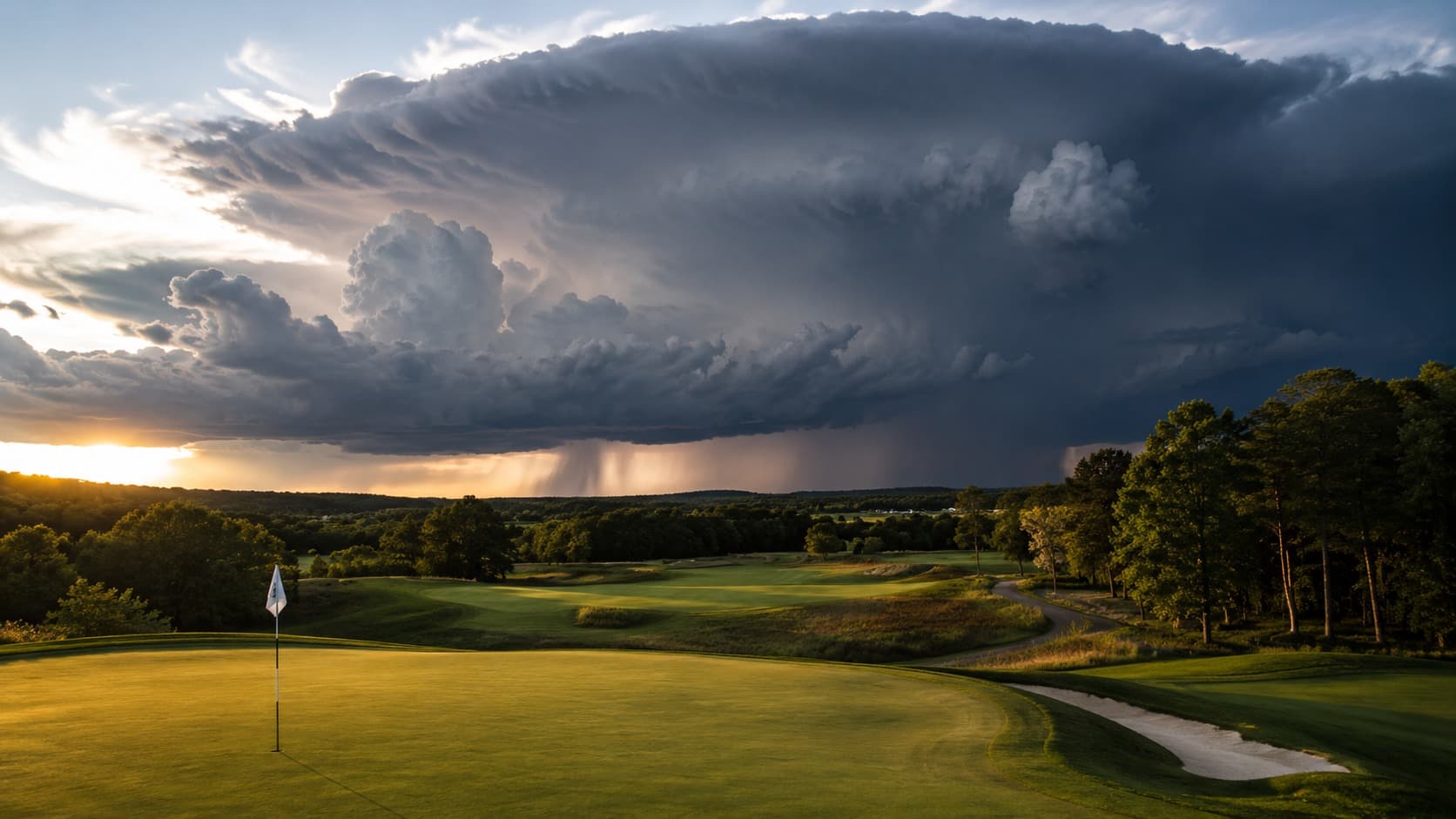
The Three O’Clock Storm: Reading Summer’s Convective Cycle to Protect Your Round
A 40% chance of afternoon thunderstorms does not mean a 40% chance of getting rained on. In the summer convective season it means the morning is nearly clear and the afternoon carries a fast-building, high-energy storm risk driven by a daily heating cycle. Here is the meteorology behind the pattern, the G-Score data on how the storm cycle punishes afternoon tee times across the Southeast, Midwest, and desert Southwest, the lightning-safety decision tree that actually matters, and the workflow that gets you off the course before the first bolt.
Read Story
Best Golf Weather by State: Ranking America by Average G-Score
We ranked all 50 US states by average G-Score golf playability. California tops the list, but the results beyond the top five may surprise you.
Read StoryMinSu Kim
Founder & Golf Data Analyst
MinSu is a data analyst and golfer with 10+ years on the course. He built Golf Weather Score to answer one question: is today a good day to play? He combines weather data, course intelligence, and the proprietary G-Score algorithm to help golfers make smarter decisions.
Every Friday Morning
When TPC Blue Monster plays best next weekend.
Friday 6am ET: peak G-Score windows for TPC Blue Monster, wind direction by hour, and one gear call. Three minutes to read, save you the round.
One email a week. Unsubscribe in one click.
The Caddie's Oracle
Draw your luck before the tee off