
Caddie's Gear Advisor
Curated for today's 76°F · Thunderstorm
Storm-Ready Outerwear
Waterproof layers built for 18 holes in the rain
Tour-Grade Umbrellas
68" double-canopy wind-resistant coverage
Wet-Weather Gloves
All-weather grip that performs in the rain
Waterproof Golf Shoes
Keep your feet dry through every fairway
Your Golf Trip, Handled
The Ultimate Golf Trip Planner
Everything you need to play TPC Scottsdale Champions Course — from booking your flight to checking in course-side.
Course-Side Stays
Luxury hotels, resorts, and stay-and-play packages just minutes from the first tee.
Flights
Compare fares across 700+ airlines for the best route to your tee time.
SUV Rentals for Golf Bags
Spacious vehicles with room for clubs, bags, and your foursome.
Travel Insurance
Coverage for medical, weather delays, and gear at your destination.
TPC Scottsdale Champions Course: Course Intelligence
Signature Setup
I walked the Champions in late February at 8 a.m., 49°F at the 1st tee with frost still sitting in the wash shadows, and the course felt twenty degrees quieter than the Stadium track a few hundred yards away. That quiet is the point of this course — it is where Scottsdale locals actually play.
The Champions opened in 1986 as TPC Scottsdale's "Desert Course," built by Tom Weiskopf and Jay Morrish on the same flat Sonoran shelf at roughly 1,510 feet. Randy Heckenkemper tore it down to the dirt in 2007 and rebuilt it with broader fairways, new bunkering, and reshaped greens, and it reopened under the Champions name. From the back markers it measures about 7,115 yards to a par of 71. It hosts Monday qualifiers and local tournaments, not the Phoenix Open circus next door.
Hole-by-Hole Wind & Playing Lines
Hole 4 (#1 handicap, par-4, 458y). The hardest hole on the card, running due southwest into the afternoon's prevailing breeze. On a 10–14 mph wind my 250-yard drive left a full 4-iron in. The fairway tilts right toward a desert margin, so aim left-center to keep the ball in the short grass, and take the front of the green every time — a back pin into that wind is a sucker target that brings the back bunker into play.
Hole 7 (par-3, 215y). The signature shot: a long iron played downhill across a dry wash to a green that is wide but only about 20 paces deep. The drop in elevation eats roughly a club, but a crossing SW wind off the right adds it straight back, so on a breezy morning the number is a wash and I play my stock 4-iron. Bail right and you are chipping back toward the water-shy front.
Hole 15 (par-4, 442y). A dogleg-left that plays longer than the yardage in the morning when the air is dense and still. Downwind later in the day the corner is reachable for long hitters; into a north wind I take the safe line down the right and accept a mid-iron, because the green falls away left and a missed pull leaves a desert lie.
Green & Fairway Characteristics
The wider, more forgiving landing zones Heckenkemper carved in 2007 are the main reason a single-digit guest finds the Champions the kinder walk of the two courses. Bermuda fairways carry winter rye from October into April and stay tight and green through the prime months; out of season the Bermuda firms and the ball chases. Daily play rolls the bentgrass greens to about 10.5 on the Stimp — a notch under tournament week next door — with gentle desert tilt that reads cleaner in flat morning light than under midday glare. Holes 4 and 15 absorb most of the afternoon wind, so the back nine is where a tidy front-side number gets put to the test. On firm desert turf into that breeze, a low driving approach holds where a high one gets pushed off line.
Seasonal Weather Pattern
The defining seasonal fact here is the late-summer monsoon: from late June into September, afternoon highs push past 105°F and humidity spikes ahead of dust-laden thunderstorm cells that can drop visibility and gust hard out of the south within minutes. Outside that stretch Scottsdale runs the national golf calendar in reverse — November through April is the peak, daytime highs in the 64–74°F band, mornings starting in the 40s and dead calm, and March warming fast with the overseed at its best. My honest limit: I've never had the Champions in the teeth of a July monsoon afternoon, so I build summer plans off NOAA monsoon-onset data instead of guessing. That data says the cells usually fire after 2 p.m., which leaves a dawn tee time as the only sane option through the wet season.
Local Play Tips
Here is something the scorecard won't show you: the Champions is the smarter booking of the two courses for a guest who wants a real round without the Stadium markup. Tee times early in the week run noticeably cheaper, the pace is calmer, and the wider Heckenkemper fairways are more forgiving when desert thermals start pushing your tee ball after 11 a.m. At 1,510 feet the ball carries longer than at sea level, and on a dry afternoon over 80°F the thin air adds even more — I take half a club off full shots once it warms and trust the firmness of the landing zone over the raw carry number.
Pre-Round Weather Workflow
Plan the Champions backwards from the 7-day G-Score on this page. The decisive variable is timing: a window before the late-morning thermal versus one after it swings the score 7–10 points, so settle that three days out. Come game day, let the windExposure panel set your strategy — a SW reading stacks holes 4 and 15 dead into the breeze, which is your cue to favor left-center off those tees and add a club coming home. And in monsoon season the radar outranks the wind speed: if the forecast carries any afternoon storm probability, grab the earliest slot on the sheet and treat anything after noon as a gamble against a gusty cell.
Related Reading
Before you tee off at TPC Scottsdale Champions Course
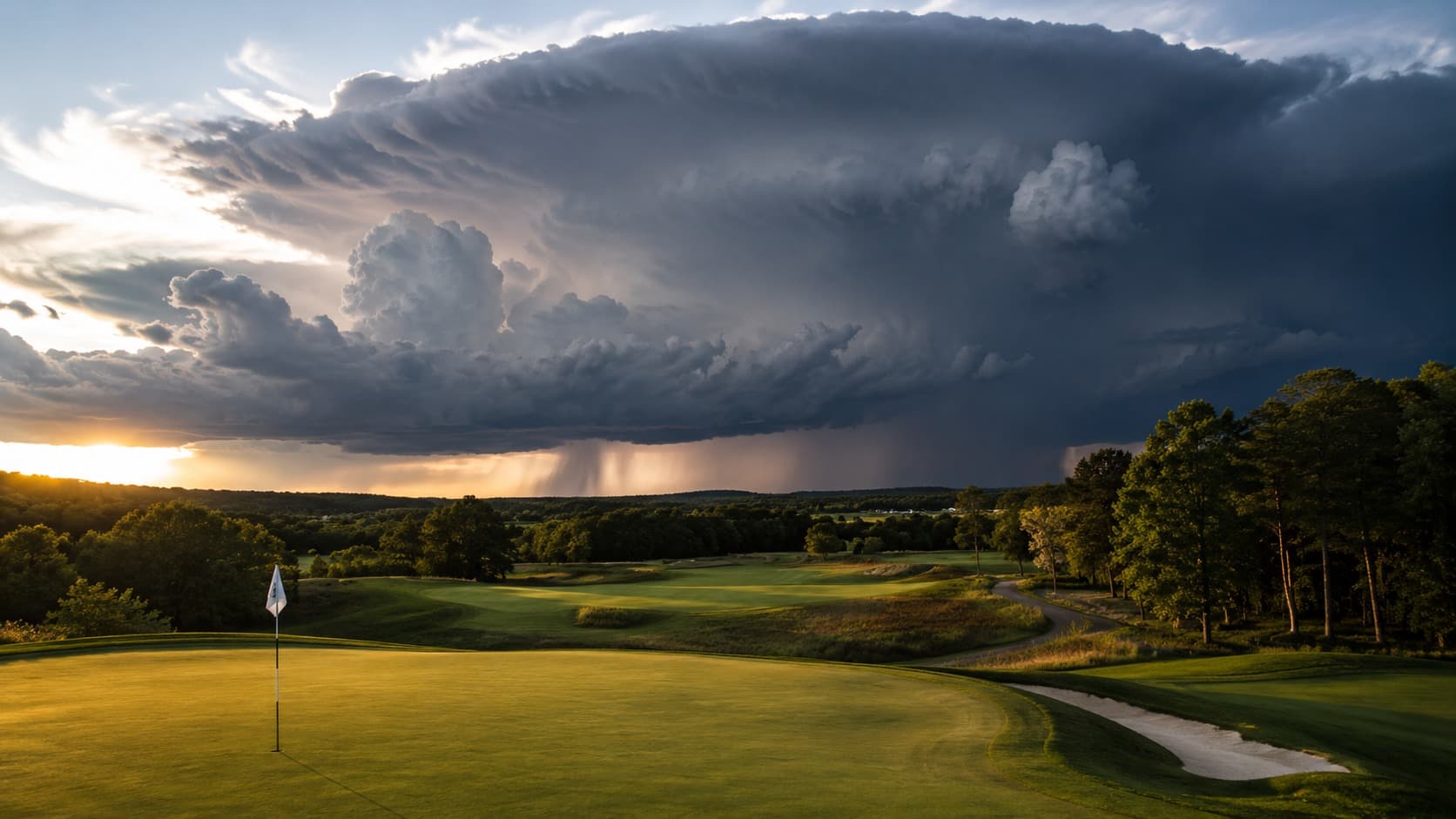
The Three O’Clock Storm: Reading Summer’s Convective Cycle to Protect Your Round
A 40% chance of afternoon thunderstorms does not mean a 40% chance of getting rained on. In the summer convective season it means the morning is nearly clear and the afternoon carries a fast-building, high-energy storm risk driven by a daily heating cycle. Here is the meteorology behind the pattern, the G-Score data on how the storm cycle punishes afternoon tee times across the Southeast, Midwest, and desert Southwest, the lightning-safety decision tree that actually matters, and the workflow that gets you off the course before the first bolt.
Read Story
The May 2026 G-Score Heatmap: Where American Golf Peaks This Spring
May is the most underrated month on the American golf calendar. Five regions hit their annual peak this spring, three turn quietly hostile, and the data tells a clearer story than the brochures. Here is where to play, where to avoid, and how to time your booking window.
Read StoryMinSu Kim
Founder & Golf Data Analyst
MinSu is a data analyst and golfer with 10+ years on the course. He built Golf Weather Score to answer one question: is today a good day to play? He combines weather data, course intelligence, and the proprietary G-Score algorithm to help golfers make smarter decisions.
Every Friday Morning
When TPC Scottsdale Champions Course plays best next weekend.
Friday 6am ET: peak G-Score windows for TPC Scottsdale Champions Course, wind direction by hour, and one gear call. Three minutes to read, save you the round.
One email a week. Unsubscribe in one click.
The Caddie's Oracle
Draw your luck before the tee off