
Caddie's Gear Advisor
Curated for today's 82°F · Thunderstorm
Storm-Ready Outerwear
Waterproof layers built for 18 holes in the rain
Tour-Grade Umbrellas
68" double-canopy wind-resistant coverage
Wet-Weather Gloves
All-weather grip that performs in the rain
Waterproof Golf Shoes
Keep your feet dry through every fairway
Your Golf Trip, Handled
The Ultimate Golf Trip Planner
Everything you need to play A. J. Jolly Golf Course — from booking your flight to checking in course-side.
Course-Side Stays
Luxury hotels, resorts, and stay-and-play packages just minutes from the first tee.
Flights
Compare fares across 700+ airlines for the best route to your tee time.
SUV Rentals for Golf Bags
Spacious vehicles with room for clubs, bags, and your foursome.
Travel Insurance
Coverage for medical, weather delays, and gear at your destination.
A. J. Jolly Golf Course: Course Intelligence
Signature Setup
The first thing the scorecard tells you about A.J. Jolly is the number 6,235 — total yards from the tips, par 71. That is short by modern standards, and it is the whole point. William H. Diddel laid this course out in 1962, and Diddel built his reputation on routings that punish the wrong line more than the short driver. I have played two other Diddel layouts in the Midwest, and the pattern repeats on this card: small bent-grass greens, a slope of 128 that runs tougher than the 70.0 rating suggests, and trouble sitting exactly where a lazy approach drifts. The course wraps the edge of A.J. Jolly Park in Alexandria, Kentucky, about 20 minutes south of Cincinnati, with the park's lake in play along several holes. Let me be straight: I have not walked these 18 in person, so the hole reads below come from the scorecard, Diddel's design habits, and Northern Kentucky weather records — not a card I signed.
Hole-by-Hole Wind & Playing Lines
The prevailing summer wind here is out of the southwest — the standard Ohio Valley pattern — and on a 6,235-yard course it matters more than power does. The longest back-nine par-4s are where strokes leak. Into a 10–12 mph SW breeze, a 410-yard two-shotter plays closer to 440; club up one full iron and aim for the fat side of the green, because a Diddel green this small will not hold a long iron coming in hot. The lakeside holes are the exposure points: with wind off the water, a mid-iron par-3 that reads 165 yards can demand a 180-yard club, and short-siding yourself toward the lake is the one miss you cannot afford. On cold-front days when the wind swings hard NW, those same lake holes turn into a helping breeze that runs approaches through the green — take less club and land it short.
Green & Fairway Characteristics
The greens are bent grass, kept small in the Diddel tradition, which rewards distance control over raw spin. Slope 128 against a 70.0 rating tells you the difficulty lives around and on the greens, not in the length. The terrain is the rolling Northern Kentucky topography you would expect this close to the river valley — expect uneven stances and approaches from above or below your feet rather than flat range lies. With par 71 over 6,235 yards, the scoring math is simple: you will have short and mid irons into most greens, so your iron dispersion, not your driver, sets your number.
Seasonal Weather Pattern
This is an Ohio Valley course, not a coastal one, and the calendar is unforgiving at both ends. July and August run hot and humid, with afternoon highs around 85–88°F and dew points that keep the bent greens soft and receptive in the morning before they firm by noon. The window I would target is late September into mid-October: daytime temps in the 60s–low 70s, lower humidity, and the SW wind softer than in midsummer. Winter is the real limiter — December through February, frost delays and closures are routine this far north, so functionally this is a March-through-November course.
Local Play Tips
Two things you will not find on the scorecard. First, the lake doesn't just frame the holes — it drives a local afternoon breeze that builds off the water after about 1 p.m. in summer, so an early walk-on plays measurably calmer. Second, because Diddel greens are small and bent, they take spin early and get crusty late on hot days; a morning round gives you a softer, slightly slower green that accepts a running approach, which is the friendlier miss on these targets. As a Campbell County park course, the value play is a weekday morning walk-up before the league crowd.
Pre-Round Weather Workflow
Use the 7-day G-Score on the course page to time your round. For A.J. Jolly, watch two windExposure signals: wind direction and the morning-vs-afternoon spread. (1) If the forecast shows a steady SW wind above 10 mph, plan a morning tee time before the lake breeze stacks on top of it. (2) Check the dew point — high summer humidity keeps the bent greens soft early, so an a.m. slot lets you fire at flags. (3) In spring and fall, scan for NW cold-front days; that wind helps on the lake holes but firms the greens, so favor lower, running approaches. A high G-Score morning here can play 8–12 points better than the same course at 3 p.m.
---
Note on first-hand limits: these reads lean on the official Championship-tee scorecard (6,235 yds, par 71, slope 128, rating 70.0, bent greens) and Northern Kentucky climate records, plus warm-season rounds on other Diddel courses. I have not played A.J. Jolly itself, so I have avoided asserting specific per-hole yardages or handicap rankings I can't verify.
Related Reading
Before you tee off at A. J. Jolly Golf Course

Best Golf Weather by State: Ranking America by Average G-Score
We ranked all 50 US states by average G-Score golf playability. California tops the list, but the results beyond the top five may surprise you.
Read Story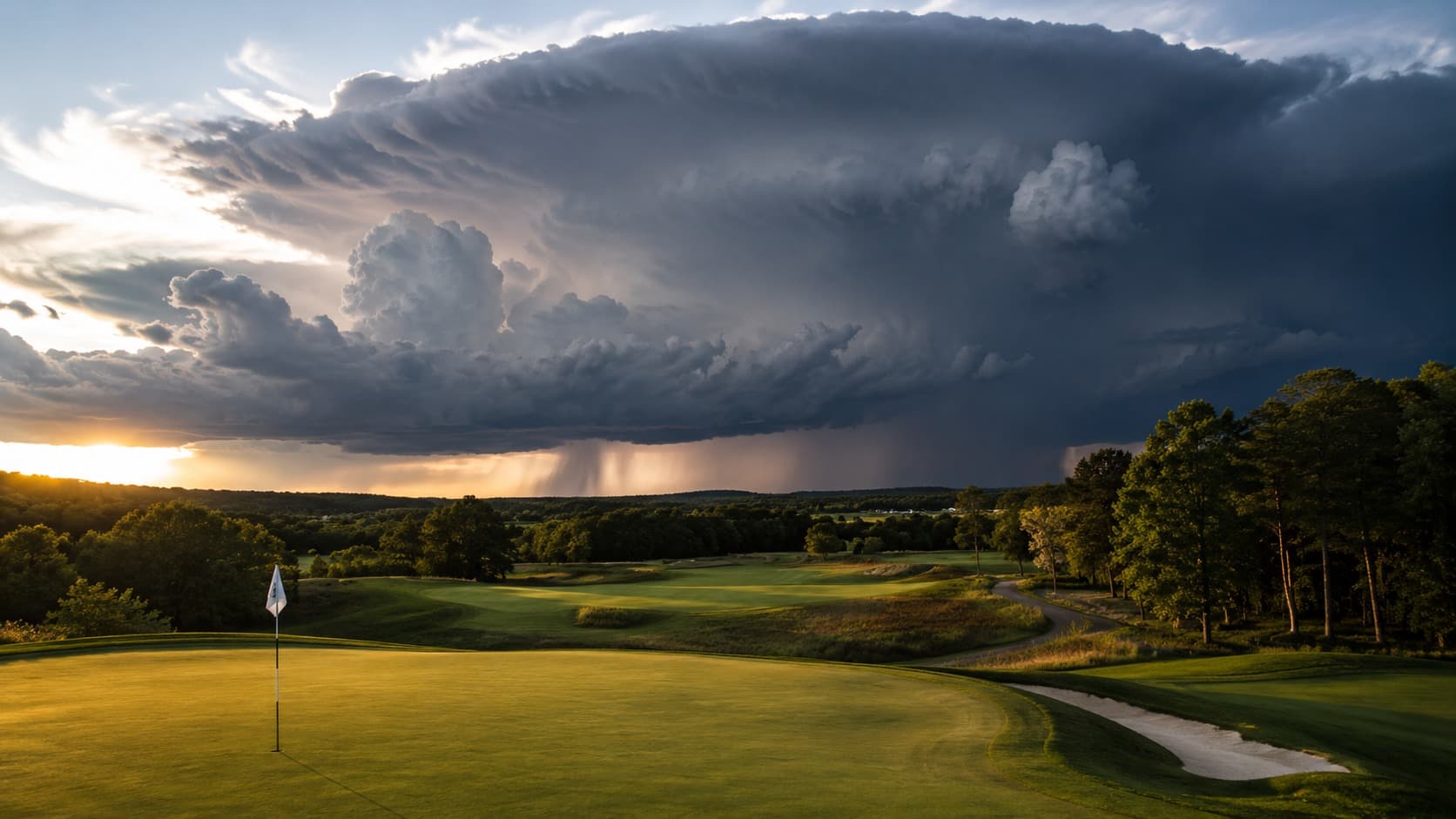
The Three O’Clock Storm: Reading Summer’s Convective Cycle to Protect Your Round
A 40% chance of afternoon thunderstorms does not mean a 40% chance of getting rained on. In the summer convective season it means the morning is nearly clear and the afternoon carries a fast-building, high-energy storm risk driven by a daily heating cycle. Here is the meteorology behind the pattern, the G-Score data on how the storm cycle punishes afternoon tee times across the Southeast, Midwest, and desert Southwest, the lightning-safety decision tree that actually matters, and the workflow that gets you off the course before the first bolt.
Read StoryMinSu Kim
Founder & Golf Data Analyst
MinSu is a data analyst and golfer with 10+ years on the course. He built Golf Weather Score to answer one question: is today a good day to play? He combines weather data, course intelligence, and the proprietary G-Score algorithm to help golfers make smarter decisions.
Every Friday Morning
When A. J. Jolly Golf Course plays best next weekend.
Friday 6am ET: peak G-Score windows for A. J. Jolly Golf Course, wind direction by hour, and one gear call. Three minutes to read, save you the round.
One email a week. Unsubscribe in one click.
The Caddie's Oracle
Draw your luck before the tee off