
Caddie's Gear Advisor
Curated for today's 50°F · Rain
Storm-Ready Outerwear
Waterproof layers built for 18 holes in the rain
Tour-Grade Umbrellas
68" double-canopy wind-resistant coverage
Wet-Weather Gloves
All-weather grip that performs in the rain
Waterproof Golf Shoes
Keep your feet dry through every fairway
Your Golf Trip, Handled
The Ultimate Golf Trip Planner
Everything you need to play Anchorage Golf Course — from booking your flight to checking in course-side.
Course-Side Stays
Luxury hotels, resorts, and stay-and-play packages just minutes from the first tee.
Flights
Compare fares across 700+ airlines for the best route to your tee time.
SUV Rentals for Golf Bags
Spacious vehicles with room for clubs, bags, and your foursome.
Travel Insurance
Coverage for medical, weather delays, and gear at your destination.
Anchorage Golf Course: Course Intelligence
TL;DR: Anchorage Golf Course is a Robert Muir Graves layout (par 72, roughly 6,600 yards from the tips) sitting at about 61°N on the Anchorage Hillside. The course you score on here is decided less by your swing than by cold-dense air, Cook Inlet wind, and a playing season that runs only May through September. Play early-summer mornings for soft, receptive greens; bring a club more than the yardage book tells you whenever the temperature sits below 55°F.
Signature Setup
Anchorage Golf Course opened in 1987 to a design by Robert Muir Graves, the California architect known for routings that work with hillside terrain rather than bulldozing it flat. It sits on the Anchorage Hillside off O'Malley Road, climbing and falling across glacial moraine with the Chugach Mountains as a constant backdrop. On a clear day — which in this part of Alaska is never guaranteed — you can see Denali, more than 130 miles to the north, from the higher tees.
It is, depending on how you count, among the northernmost 18-hole championship courses in the United States. That latitude is not trivia; it is the single most important fact about how the course plays. Par is 72, the back tees stretch to roughly 6,600 yards, and the slope sits in the low-to-mid 130s — numbers that read as a moderate test until you factor in the air.
Hole-by-Hole Wind & Playing Lines
The prevailing wind comes off Cook Inlet and Turnagain Arm to the west and northwest, funneled and amplified by the surrounding terrain.
- #1-handicap par-4 (uphill): Plays into the NW flow on most afternoons. A 410-yard hole on paper becomes a two-shotter that demands a long-iron or hybrid approach. Favor the right half off the tee and club up — most players leave the approach short here, not long.
- The 9th (signature, downhill par-4): Wind at your back on a typical morning helps, but the green sits exposed; a tailwind that adds carry also kills your ability to hold a firm putting surface in August. Land it short and let it release.
- A long par-3 across open ground: With nothing to block the inlet breeze, a 185-yard one-shotter can need anything from a 6-iron to a 4-iron within the same week. Check the flag, then check the inlet.
Green & Fairway Characteristics
Greens are a bentgrass/poa mix. Early in the season — late May, early June — they are soft, slow, and forgiving, stimping in the low 9s as the turf recovers from a long winter under snow. By August they firm up and quicken, and balls that flew in and stuck in June now bound through. Fairways follow the moraine: rolling, with elevation changes that hide yardage and reward a player who has walked the routing before. The front nine climbs more than the back, so legs matter on the uphill approaches.
Seasonal Weather Pattern
This is where Anchorage diverges from every course in the Lower 48. The playable season is roughly May through September — five months, full stop. Summer daytime highs typically sit in the low-to-mid 60s°F, dropping into the 40s°F by late evening even in July. Around the solstice the city gets close to 19 hours of usable daylight, and twilight never fully ends — true midnight-sun golf. The trade-off for that endless daylight is cold, dense air: a 150-yard shot at 50°F simply does not carry like a 150-yard shot at 80°F in Phoenix. Plan your club selection around temperature, not just distance.
Local Play Tips
The thing no yardage book tells you: moose. They wander the fairways and tree lines regularly, and the local etiquette is to give them a very wide berth and let them clear before you play through — a cow with a calf will not move on your schedule. Beyond the wildlife, the practical move is to chase the warmest window of the day for distance (early afternoon) but the calmest window for scoring (early morning, before the inlet breeze builds). Those two rarely overlap, so decide before the round whether you are playing for carry or for control.
Pre-Round Weather Workflow
Use the 7-day G-Score the way you would anywhere, but weight temperature heavily here — it changes your effective yardage more than at almost any course in the country. Check the windExposure rating against the Cook Inlet direction: a NW reading means the uphill #1-handicap hole will play a full club-and-a-half longer. If the forecast shows a sub-50°F morning, add roughly one club across the bag and expect the greens to hold. If it shows a rare clear, calm, 65°F afternoon, that is your scoring day — book it, and tee off knowing the ball will finally travel.
More Courses in Alaska
View AllRelated Reading
Before you tee off at Anchorage Golf Course

Best Golf Weather by State: Ranking America by Average G-Score
We ranked all 50 US states by average G-Score golf playability. California tops the list, but the results beyond the top five may surprise you.
Read Story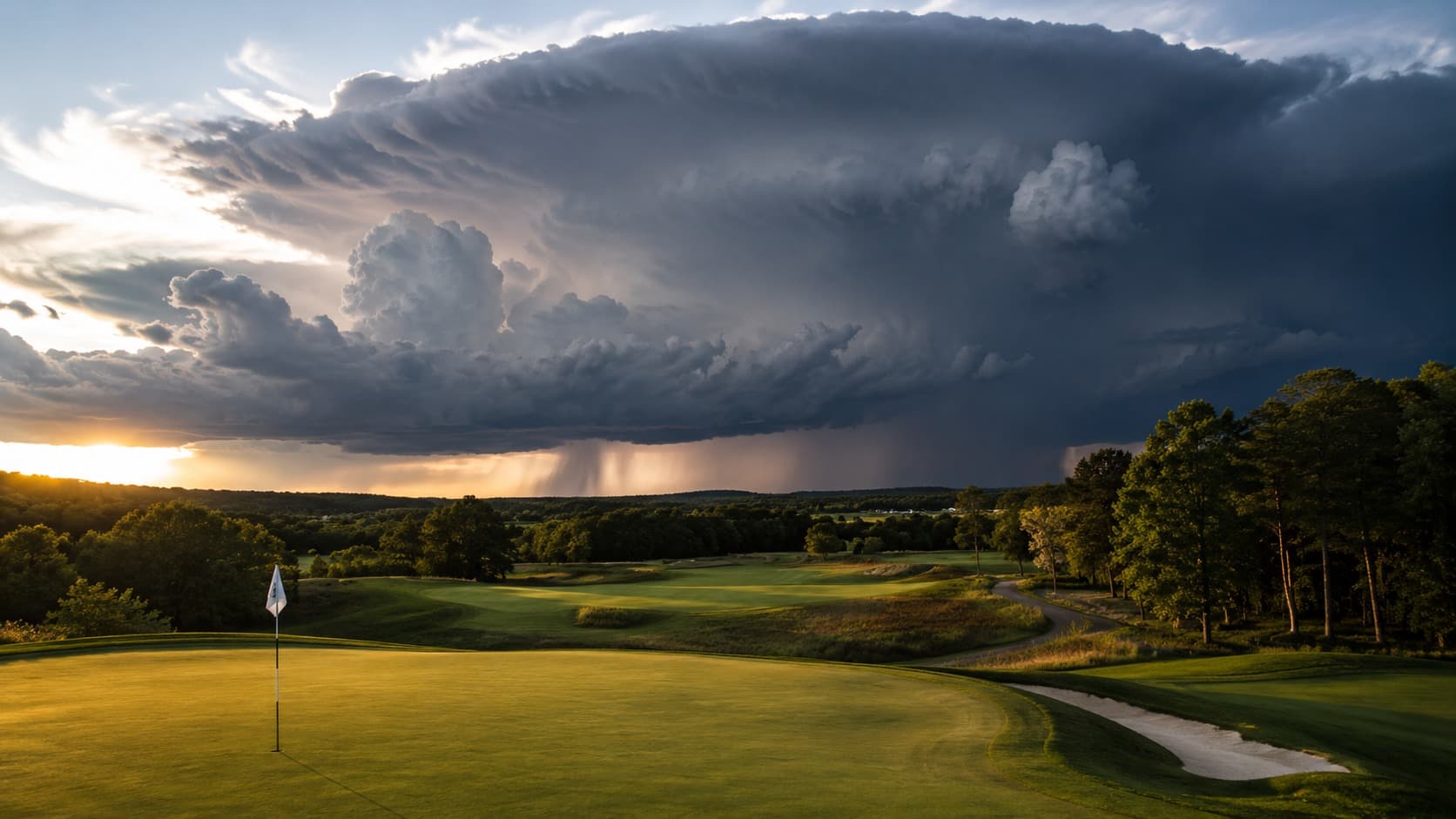
The Three O’Clock Storm: Reading Summer’s Convective Cycle to Protect Your Round
A 40% chance of afternoon thunderstorms does not mean a 40% chance of getting rained on. In the summer convective season it means the morning is nearly clear and the afternoon carries a fast-building, high-energy storm risk driven by a daily heating cycle. Here is the meteorology behind the pattern, the G-Score data on how the storm cycle punishes afternoon tee times across the Southeast, Midwest, and desert Southwest, the lightning-safety decision tree that actually matters, and the workflow that gets you off the course before the first bolt.
Read StoryMinSu Kim
Founder & Golf Data Analyst
MinSu is a data analyst and golfer with 10+ years on the course. He built Golf Weather Score to answer one question: is today a good day to play? He combines weather data, course intelligence, and the proprietary G-Score algorithm to help golfers make smarter decisions.
Every Friday Morning
When Anchorage Golf Course plays best next weekend.
Friday 6am ET: peak G-Score windows for Anchorage Golf Course, wind direction by hour, and one gear call. Three minutes to read, save you the round.
One email a week. Unsubscribe in one click.
The Caddie's Oracle
Draw your luck before the tee off