
Caddie's Gear Advisor
Curated for today's 77°F · Clear
Tour-Level Drivers
Engineered for maximum distance and forgiveness
Laser Rangefinders
Pin-seeking technology for precision approaches
Premium Golf Balls
Tour-caliber spin and distance performance
Performance Sunglasses
Polarized lenses optimized for reading greens
Your Golf Trip, Handled
The Ultimate Golf Trip Planner
Everything you need to play Beacon Lakes Golf Club — from booking your flight to checking in course-side.
Course-Side Stays
Luxury hotels, resorts, and stay-and-play packages just minutes from the first tee.
Flights
Compare fares across 700+ airlines for the best route to your tee time.
SUV Rentals for Golf Bags
Spacious vehicles with room for clubs, bags, and your foursome.
Travel Insurance
Coverage for medical, weather delays, and gear at your destination.
Beacon Lakes Golf Club: Course Intelligence
Signature Setup
Golf on the Texas Gulf Coast has a clock to it. I've teed off around Galveston Bay enough mornings to know the pattern: dead-calm and sticky at 7 a.m., then the southeast sea breeze builds off the water by early afternoon and reorganizes the whole round. Beacon Lakes sits right in that weather — Dickinson, Texas, about 20 miles inland from Galveston.
I'll be straight that I'm reading this one off the scorecard and the layout rather than a round I've walked, so the hole specifics below come from the course data, not my own memory of the greens. Beacon Lakes Golf Club opened in 1996, designed by Jerry Wilson, and plays 6,777 yards to a par of 72 from the gold tees (rating 72.8, slope 126). Its real signature isn't a single hole — it's that the whole property is a lighted championship facility, so this is one of the few full 18s in the Houston-Galveston corridor you can play deep into a summer evening.
Hole-by-Hole Wind & Playing Lines
Hole 4 (par-4, 421y gold — #1 handicap). The hardest hole on the card by index. At 421 it already demands two clean shots, and on a typical Gulf afternoon the SE breeze adds the rest. My rule on a long Texas-coast par-4 into the sea breeze is to stop fighting it: lay the second shot back to a full wedge yardage instead of forcing a long iron that the wind balloons and pushes. Play it as a soft three-shotter and you'll card more bogeys than doubles.
Hole 7 (par-3, 220y gold — #5 handicap). The longest one-shot hole here and the tee shot I'd respect most. 220 yards is a fairway wood or hybrid for most players before you add wind; if the afternoon breeze is into or across you, that's the difference between a green you can hold and one that releases over the back. Early in the day, before the breeze, it's a far more reachable number.
Hole 3 (par-4, 407y gold — #3 handicap). The other long two-shotter on the front. Same discipline as 4 — when the wind is up, the smart miss is short and center, not long-and-dead.
Green & Fairway Characteristics
This is coastal-prairie golf: low, flat ground a short hop from Galveston Bay, warm-season bermuda turf, and water and sand traps that the course itself names as its main defenses (the "Lakes" in the name is not decorative). The front nine runs from a 141-yard par-3 at the 2nd up to a 545-yard par-5 at the 5th, so club selection swings widely hole to hole. Flat terrain means the ground stays in play — in humid coastal air an aerial wedge spins less than you expect, and on firm bermuda a slightly low, running approach is the more repeatable shot. With a slope of 126 from the gold tees, it rewards position over power: keep the ball dry off the tee and let the wedges do the scoring.
Seasonal Weather Pattern
Dickinson sits in a humid subtropical Gulf climate, and the season splits cleanly. June through September is hot and sticky — afternoon highs in the low-to-mid 90s°F with high humidity and pop-up thunderstorms — and it's also Atlantic hurricane season (June through November), so check the tropical outlook, not just the daily forecast, before booking a coastal Texas trip. The afternoon SE sea breeze off the Gulf is the defining daily feature: it cools things slightly but turns every long hole into the wind. Winters are mild — daytime 60s°F is common — which makes November through February the most comfortable, most playable scoring window. I haven't played here in a January norther, so I won't guess at how the greens roll cold; NOAA coastal records just show the mild, occasionally wind-whipped pattern typical of the upper Texas coast.
Local Play Tips
The local edge here is the lighting. Because Beacon Lakes is a fully lighted 18, you don't have to surrender a summer round to the worst of the heat and the strongest part of the sea breeze. Book your tee time for the evening: the temperature drops out of the 90s, the afternoon Gulf wind typically eases after sunset, and the long holes (3, 4, 7) play closer to their honest yardage than they do at 2 p.m. into a 12–15 mph breeze. If you must play midday in summer, double your water and expect the wind to cost you a club or two on every shot pointed south or southeast.
Pre-Round Weather Workflow
Use the 7-day G-Score on this course page to time the round, not just to confirm it. Three days out, look at whether your window falls in the calm morning, the breezy afternoon, or the post-sunset lull — on a flat coastal layout that timing alone can move your score 8–12 points. The morning of, read the windExposure panel for direction: a building SE sea breeze means the long holes (3, 4, 7) play into the wind while shorter, sheltered holes stay manageable, so save your conservative lay-up plan for the into-wind stretch. In summer, also glance at the tropical/storm outlook before you drive out — Gulf afternoon thunderstorms build fast — and if the forecast shows wind over a steady 12 mph, commit to the low running approach and add a club into anything aimed at the water.
Related Reading
Before you tee off at Beacon Lakes Golf Club

Best Golf Weather by State: Ranking America by Average G-Score
We ranked all 50 US states by average G-Score golf playability. California tops the list, but the results beyond the top five may surprise you.
Read Story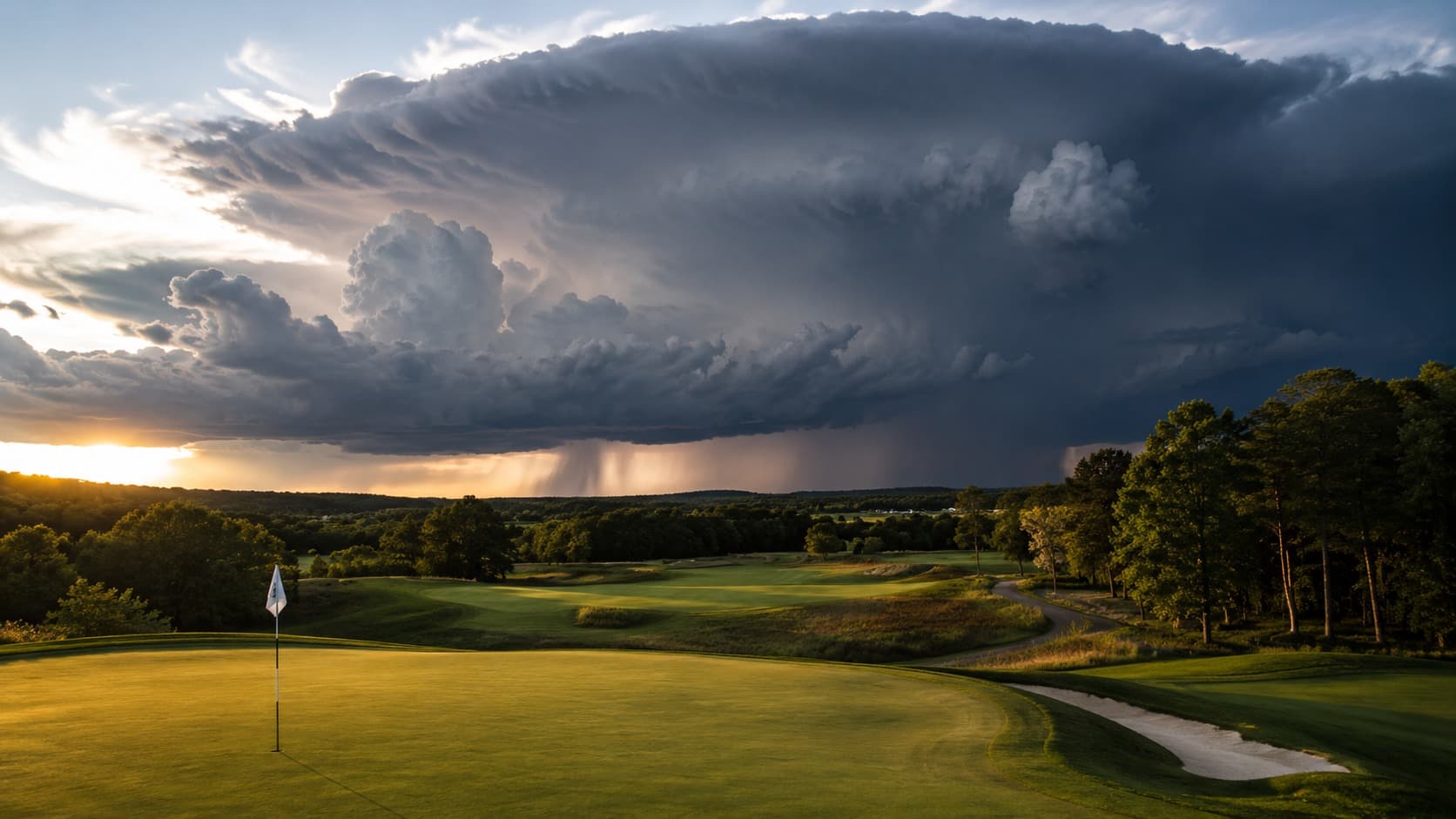
The Three O’Clock Storm: Reading Summer’s Convective Cycle to Protect Your Round
A 40% chance of afternoon thunderstorms does not mean a 40% chance of getting rained on. In the summer convective season it means the morning is nearly clear and the afternoon carries a fast-building, high-energy storm risk driven by a daily heating cycle. Here is the meteorology behind the pattern, the G-Score data on how the storm cycle punishes afternoon tee times across the Southeast, Midwest, and desert Southwest, the lightning-safety decision tree that actually matters, and the workflow that gets you off the course before the first bolt.
Read StoryMinSu Kim
Founder & Golf Data Analyst
MinSu is a data analyst and golfer with 10+ years on the course. He built Golf Weather Score to answer one question: is today a good day to play? He combines weather data, course intelligence, and the proprietary G-Score algorithm to help golfers make smarter decisions.
Every Friday Morning
When Beacon Lakes Golf Club plays best next weekend.
Friday 6am ET: peak G-Score windows for Beacon Lakes Golf Club, wind direction by hour, and one gear call. Three minutes to read, save you the round.
One email a week. Unsubscribe in one click.
The Caddie's Oracle
Draw your luck before the tee off