
Caddie's Gear Advisor
Curated for today's 63°F · Clouds
Tour-Level Drivers
Engineered for maximum distance and forgiveness
Laser Rangefinders
Pin-seeking technology for precision approaches
Premium Golf Balls
Tour-caliber spin and distance performance
Performance Sunglasses
Polarized lenses optimized for reading greens
Your Golf Trip, Handled
The Ultimate Golf Trip Planner
Everything you need to play Cape Neddick Golf Club — from booking your flight to checking in course-side.
Course-Side Stays
Luxury hotels, resorts, and stay-and-play packages just minutes from the first tee.
Flights
Compare fares across 700+ airlines for the best route to your tee time.
SUV Rentals for Golf Bags
Spacious vehicles with room for clubs, bags, and your foursome.
Travel Insurance
Coverage for medical, weather delays, and gear at your destination.
Cape Neddick Golf Club: Course Intelligence
TL;DR
Cape Neddick Country Club in Ogunquit, Maine is a 6,257-yard, par-70 semi-private layout with a Donald Ross original nine (1919) and a Brian Silva nine (1996). It rates 70.1 with a slope of 125 on bentgrass greens. The defining variable here is southern Maine coastal weather — onshore fog, damp morning air, and an Atlantic breeze that lengthens uphill holes like the par-5 3rd. Read the moisture before you read the yardage.
Signature Setup
The original nine at Cape Neddick traces back to Donald J. Ross and the 1919 founding of the club; the second nine was added by Brian M. Silva in 1996, which is why the routing reads as two distinct personalities stitched together. I haven't walked this property myself, so I'm working from the scorecard, the club's own hole notes, and a decade of rounds on southern Maine's coast near York and Ogunquit — and I'll flag where that line is. At 6,257 yards and par 70 from the tips, this is not a bomber's course; the rating of 70.1 against a slope of 125 tells you it defends par with position and green complexes, not length. The 8th is the club's most picturesque par-3, and the 3rd — a blind, uphill par-5 — is the one players talk about as the toughest test on the card.
Hole-by-Hole Wind & Playing Lines
Hole 3 (par-5, hardest hole): The second shot is blind and uphill, so it already plays longer than the number. On a damp onshore morning off the Atlantic, that uphill leg eats another half-club. My read from the regional pattern: when the breeze is in your face climbing the hill, take the layup — a flat lie 90 yards out beats a flier from a side-hill lie.
Hole 9 (forced carry): This is the only true forced carry on the course, over wetland. In morning humidity the carry distance feels honest but the run-out disappears on wet turf — commit to enough club to clear, because bailing short leaves a damp, grabby lie.
Hole 10 (most difficult par-4): Water and out-of-bounds are both in play. With a crosswind off the coast, the OB side gets magnetic; favor the safe side and accept a longer approach rather than flirting with the boundary.
Green & Fairway Characteristics
The greens are bentgrass — they take and hold a well-struck iron, and on a still, dewy morning they roll true but slower than they look. The terrain is the story: the course runs across rolling ground near Shore Road with genuine uphill and downhill holes, so lies are rarely dead flat. Doglegs and risk-reward angles run throughout — classic Ross instinct on the front, with Silva's nine adding the wetland and water teeth. Total yardage of 6,257 means you're often hitting mid-irons into these green complexes, where misses get punished by slope rather than rough.
Seasonal Weather Pattern
Southern Maine's coast is its own microclimate. Spring mornings in May commonly sit in the upper 40s to low 50s°F with heavy dew and frequent sea fog; the ball does not run, and uphill holes play their full length. Peak season — late June through August — brings daytime highs in the 70s°F, but the Atlantic keeps mornings cool and humid, so the fairways stay soft until the fog lifts. By September and October the air dries and firms up, the best scoring window of the year, though afternoon onshore wind picks up. This is a markedly cooler, damper profile than inland Maine courses sitting just 30 miles west.
Local Play Tips
The single most useful thing I'd tell a first-timer: book the earliest tee time you can stomach in summer, then respect the fog. Damp, fog-laden fairways kill roll, so the layout effectively plays longer than 6,257 yards in the morning — club up one on every approach until the turf dries. Because it's semi-private but open to public tee times, weekday mornings are both quieter and firmer-running once the sun is up. And on the blind 3rd, pick a fixed aiming landmark on the horizon before you climb — you can't see the landing area, and second-guessing the blind shot is how the hole wins.
Pre-Round Weather Workflow
Use the 7-day G-Score on this course page as your first filter. For Cape Neddick, weight two factors heavily: morning humidity/fog probability and onshore wind direction. A high G-Score morning here means low fog, a dry-ish breeze, and firmer turf — take it and play the early slot. If the forecast shows heavy dew or marine fog, plan for the course to play 200–300 yards longer overall and add a club to every iron. Check the windExposure indicator before the round: an onshore (easterly) breeze stiffens the uphill 3rd and pushes balls toward the OB on 10, so adjust your aim lines off the tee accordingly. Re-check the morning of — coastal Maine conditions swing fast.
Related Reading
Before you tee off at Cape Neddick Golf Club

The May 2026 G-Score Heatmap: Where American Golf Peaks This Spring
May is the most underrated month on the American golf calendar. Five regions hit their annual peak this spring, three turn quietly hostile, and the data tells a clearer story than the brochures. Here is where to play, where to avoid, and how to time your booking window.
Read Story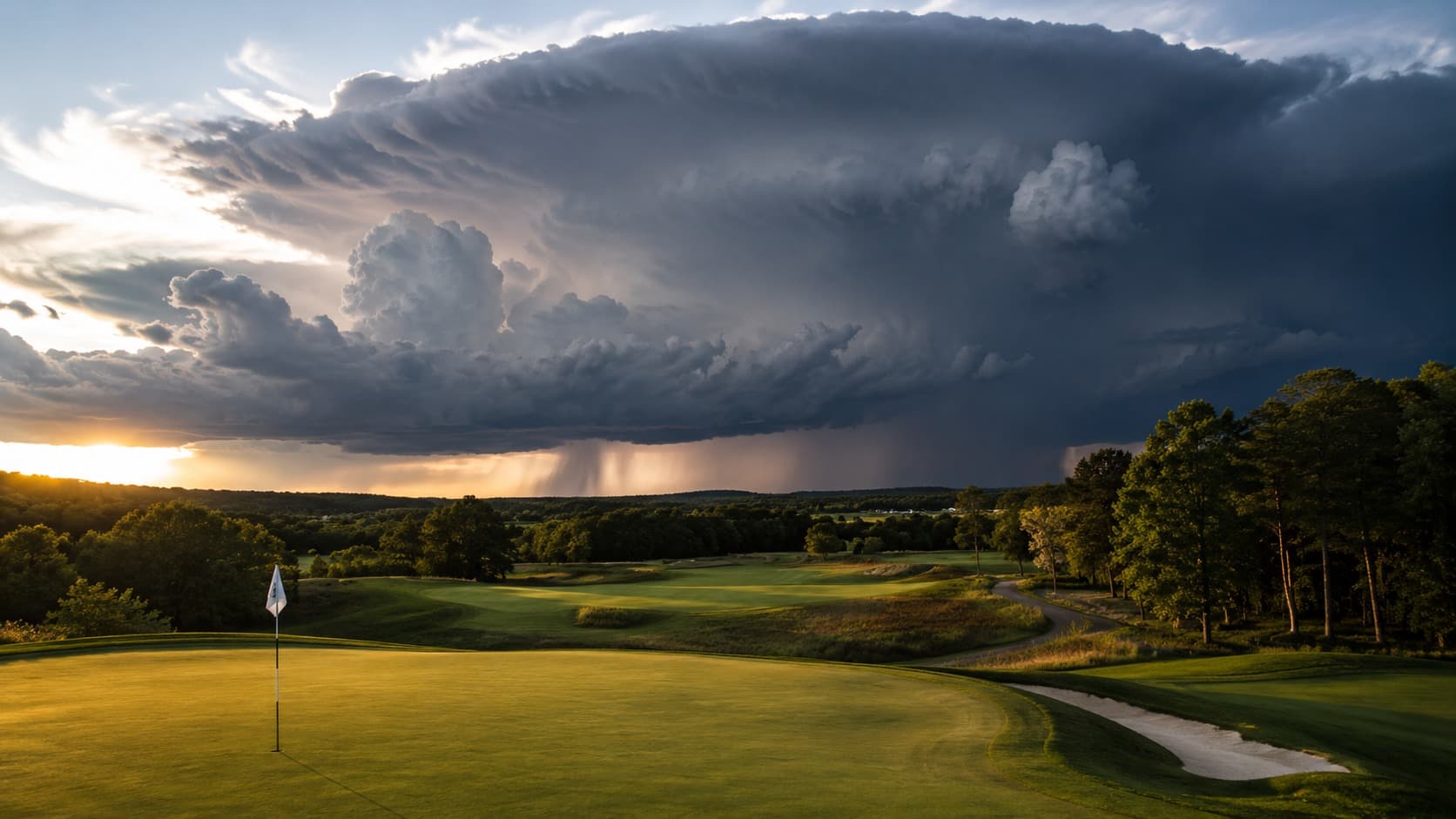
The Three O’Clock Storm: Reading Summer’s Convective Cycle to Protect Your Round
A 40% chance of afternoon thunderstorms does not mean a 40% chance of getting rained on. In the summer convective season it means the morning is nearly clear and the afternoon carries a fast-building, high-energy storm risk driven by a daily heating cycle. Here is the meteorology behind the pattern, the G-Score data on how the storm cycle punishes afternoon tee times across the Southeast, Midwest, and desert Southwest, the lightning-safety decision tree that actually matters, and the workflow that gets you off the course before the first bolt.
Read StoryMinSu Kim
Founder & Golf Data Analyst
MinSu is a data analyst and golfer with 10+ years on the course. He built Golf Weather Score to answer one question: is today a good day to play? He combines weather data, course intelligence, and the proprietary G-Score algorithm to help golfers make smarter decisions.
Every Friday Morning
When Cape Neddick Golf Club plays best next weekend.
Friday 6am ET: peak G-Score windows for Cape Neddick Golf Club, wind direction by hour, and one gear call. Three minutes to read, save you the round.
One email a week. Unsubscribe in one click.
The Caddie's Oracle
Draw your luck before the tee off