
Caddie's Gear Advisor
Curated for today's 54°F · Clear
Cold-Weather Performance Layers
Thermal mid-layers that move with your swing
Tour Hand Warmers
Rechargeable warmers trusted by caddies
Thermal Base Layers
Lightweight compression that traps heat
Winter Golf Headwear
Beanies and ear warmers built for the links
Your Golf Trip, Handled
The Ultimate Golf Trip Planner
Everything you need to play Capital Canyon Club — from booking your flight to checking in course-side.
Best time to golf in ArizonaCourse-Side Stays
Luxury hotels, resorts, and stay-and-play packages just minutes from the first tee.
Flights
Compare fares across 700+ airlines for the best route to your tee time.
SUV Rentals for Golf Bags
Spacious vehicles with room for clubs, bags, and your foursome.
Travel Insurance
Coverage for medical, weather delays, and gear at your destination.
Capital Canyon Club: Course Intelligence
Signature Setup
Capital Canyon Club sits in the high country of Prescott, Arizona, at roughly 5,400 feet of elevation — a Tom Weiskopf design that opened in 2002 as Hassayampa Golf Club before its rename. This is not Scottsdale desert golf. The corridors thread through ponderosa pine, scrub oak, and exposed granite outcroppings, and the property tilts and folds with the surrounding foothills of the Bradshaw Mountains rather than sitting flat on a graded pad.
Weiskopf's routing here leans on natural drainage draws and elevation change instead of manufactured mounding. Several tee shots play from elevated boxes down into valleys, then back up to greens benched into the slope — the kind of vertical movement that makes club selection a guessing game until you've played it twice. The course plays a par 72 of roughly 6,900 yards from the tips, with multiple tee sets that swing the experience from a tight 5,200-yard test to a full-length one.
Hole-by-Hole Wind & Playing Lines
The defining weather variable here is not just wind direction but the thin air. At 5,400 feet, the ball carries roughly 8–10% farther than at sea level (a widely cited rule of about 2% per 1,000 feet) — so a stock 150-yard 8-iron can fly closer to 162–165. The mistake first-time visitors make is over-clubbing on calm mornings and flying greens.
On the #1 handicap par-4, the hole plays uphill into the prevailing afternoon southwest flow that funnels off the Bradshaws. The altitude carry and the headwind partially cancel each other — net it out to about one extra club, and favor the right half of the fairway to stay clear of the granite line that crowds the left.
On exposed ridge holes, a north or northwest wind in the cooler months can knock 15–20 yards off a downwind-looking approach because the colder, denser air at 45–55°F reduces the altitude carry advantage. When the morning reads 48°F, I treat the elevation bonus as nearly gone and club as if I were near sea level.
Green & Fairway Characteristics
The greens are bentgrass — a cool-season choice that suits Prescott's elevation far better than the Bermuda you'd find 90 minutes south in Phoenix. They run in the mid-10s on the Stimpmeter under normal member conditions and get genuinely quick and firm when the high-desert air dries them out in late spring. Putts break harder toward the lower valley floor than your eye expects; the mountain backdrop fools your read.
Fairways are a ryegrass/bluegrass mix that stays firm. Several holes are mild doglegs that bend with the terrain, and front-nine to back-nine yardage is fairly balanced, but the back carries more of the dramatic elevation drops. Where the turf is firm and downhill, a well-struck mid-iron will release well past pitch mark — plan for the bounce, not just the carry.
Seasonal Weather Pattern
Prescott's four-season climate is the real story. Summer highs sit around 88–90°F in July — far milder than the 110°F+ of the Valley — with cool mornings in the 60s that make early tee times genuinely pleasant. But July into early September is monsoon season: afternoon thunderstorms build fast over the Bradshaw Mountains, often between 1 and 4 p.m., bringing lightning risk that closes courses quickly.
Spring and fall are the prime windows — dry, stable, daytime temps in the 70s. Winter is real here: overnight lows dip below freezing, frost delays are common in December and January, and Prescott does occasionally get snow that closes play for a day or two. I haven't played it in deep winter, so I'd lean on local frost-delay reports rather than assume a clean morning round.
Local Play Tips
The single most useful piece of local knowledge: the monsoon timing. From roughly July 4 through Labor Day, the safe play is a tee time before 10 a.m. The morning sky can look perfectly clear and still produce a building thunderhead by early afternoon — the orographic lift off the surrounding mountains is reliable enough that locals plan their whole summer schedule around it.
Second tip: respect the cool mornings even in summer. A 62°F start means your first few holes give you noticeably less altitude carry than the same shot will at 1 p.m. when it's 86°F and the air has thinned with heat. I've seen players short-side themselves on early approaches simply because they hadn't recalibrated for the morning chill.
Pre-Round Weather Workflow
Use the 7-day G-Score forecast to find your window. For Capital Canyon Club specifically:
- Check the afternoon thunderstorm probability in summer — if convective risk spikes after noon, move your tee time earlier. A high G-Score morning can flip to unplayable by 2 p.m. in monsoon season.
- Read the windExposure rating for the ridge holes — a northwest flow in cool months meaningfully cuts your altitude carry, so adjust club selection up.
- Watch the morning low temperature in the 7-day view. Below ~50°F, treat the elevation distance bonus as reduced; in the 80s, expect maximum carry.
- In winter, confirm there's no frost delay before driving up — Prescott's elevation means frozen mornings are routine from December through February.
Match your tee time to the highest-scoring weather window and you'll play this Weiskopf layout the way it was meant to be played: firm, fast, and rewarding to anyone who clubs honestly for the thin mountain air.
Related Reading
Before you tee off at Capital Canyon Club
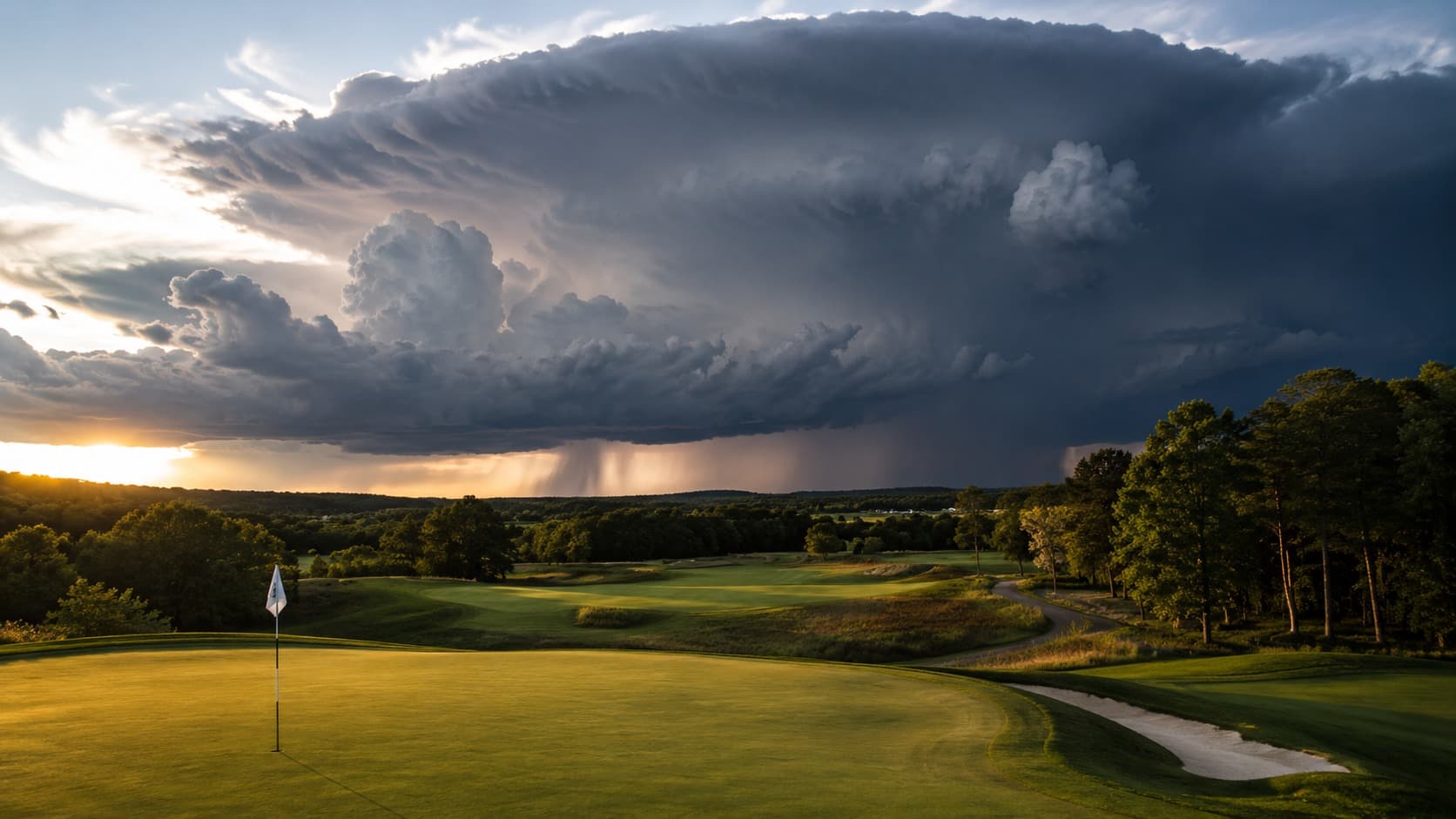
The Three O’Clock Storm: Reading Summer’s Convective Cycle to Protect Your Round
A 40% chance of afternoon thunderstorms does not mean a 40% chance of getting rained on. In the summer convective season it means the morning is nearly clear and the afternoon carries a fast-building, high-energy storm risk driven by a daily heating cycle. Here is the meteorology behind the pattern, the G-Score data on how the storm cycle punishes afternoon tee times across the Southeast, Midwest, and desert Southwest, the lightning-safety decision tree that actually matters, and the workflow that gets you off the course before the first bolt.
Read Story
America's 20 Windiest Golf Courses: A G-Score Wind Analysis
We ranked America's 20 windiest golf courses using G-Score wind penalty data. See how coastal gusts and prairie gales reshape playability scores.
Read StoryDanorie
Editorial & Data
Golf Weather Score is built by Danorie. We compute the G-Score — our own playability rating — from live NOAA forecasts and published course scorecards, so any US course can be compared on any day with a single number. Methodology and data sources are documented on every page.
Every Friday Morning
When Capital Canyon Club plays best next weekend.
Friday 6am ET: peak G-Score windows for Capital Canyon Club, wind direction by hour, and one gear call. Three minutes to read, save you the round.
One email a week. Unsubscribe in one click.
The Caddie's Oracle
Draw your luck before the tee off