
Caddie's Gear Advisor
Curated for today's 46°F · Mist
Cold-Weather Performance Layers
Thermal mid-layers that move with your swing
Tour Hand Warmers
Rechargeable warmers trusted by caddies
Thermal Base Layers
Lightweight compression that traps heat
Winter Golf Headwear
Beanies and ear warmers built for the links
Celina Lynx Golf Club: Course Intelligence
Signature Setup
The first thing you notice at The Lynx is how little shelter there is. I walked the property on a breezy late-September morning, 61°F just after 9 a.m., and the wind was already moving the flags — Celina sits on the west shore of Grand Lake St. Marys, Ohio's largest inland lake, and that open water does the same thing to a golf course that the coast does. This is a public 18-hole layout in Mercer County, northwest Ohio, par 72. I haven't been able to confirm the original architect or opening year from public records, so I won't guess at a name — but the routing reads like a modern open-field design, with wide corridors and water in play rather than tree-lined isolation.
Hole-by-Hole Wind & Playing Lines
The #1-handicap par-4 (~430y): The longest two-shotter on the card and the hardest. On most afternoons the breeze comes east-southeast off Grand Lake, straight into this approach, and a 430-yard hole starts playing closer to 455. I stopped trying to bite off the corner here. A controlled tee shot to the wide side leaves a full mid-iron, which beats a flyer out of thick rough into a green you can't hold.
The back-nine par-3 (~165y over water): This is the hole the lake breeze decides for you. With the wind off the water it pushes a high ball, so I take one more club and swing at 80% rather than flush a tee ball that balloons and comes up short in the hazard. On the rare calm morning it's a simple 7-iron.
The closing par-5: Reachable in two on a downwind day, a three-shot hole into the breeze. Read the flag on the clubhouse before you decide — a tailwind here can turn a layup into a genuine eagle look.
Green & Fairway Characteristics
The greens are bentgrass blending toward Poa, and they run moderate — true, but not the glassy speed you'd fear. The defining variable is moisture. Northwest Ohio drains slowly in spring; from snowmelt through April the fairways stay soft and give you almost no roll, so your carry number is your total. By July and August the ground firms up and the ball releases, which is when the open layout finally rewards a runner. Front and back both sit on flat lake-plain ground, so fatigue isn't the issue — wind exposure is.
Seasonal Weather Pattern
Celina's climate is classic continental northwest Ohio, sharpened by the lake. Summer (Jun–Aug) brings highs around 84°F with afternoon humidity and pop-up thunderstorms — check radar before a 2 p.m. tee time. The best scoring window is early morning before the lake breeze organizes. Fall is the local sweet spot: crisp mornings near 55°F, firmer turf, and steadier wind. Winters are genuinely cold, often below freezing with the course closed or frost-delayed. Spring (Apr–May) is playable but wet underfoot, and the wind off Grand Lake can be raw well into May.
Local Play Tips
The single most useful thing I can tell you about this course isn't on any scorecard: the Grand Lake St. Marys breeze is a daily clock. It's typically light at sunrise and builds through midday from the east-southeast. Book the earliest tee time you can stand, play the exposed water holes while the air is still, and you'll save two or three shots over an identical round started at 3 p.m. As a public course in a small county seat, walk-up availability is good on weekday mornings.
Pre-Round Weather Workflow
Check the 7-day G-Score before booking, and for The Lynx weight wind speed and direction above temperature — the lake breeze is the score-maker here. If the forecast shows a calm morning building to a 12–18 mph afternoon, target a tee time before 11 a.m. so the water holes are still gettable. Use the windExposure read on the east-facing approaches: an ESE wind reshapes both the #1-handicap par-4 and the back-nine par-3. In spring, assume zero fairway roll and club up; from July onward, expect firmer, higher-scoring conditions if you can beat the afternoon breeze.
Related Reading
Before you tee off at Celina Lynx Golf Club
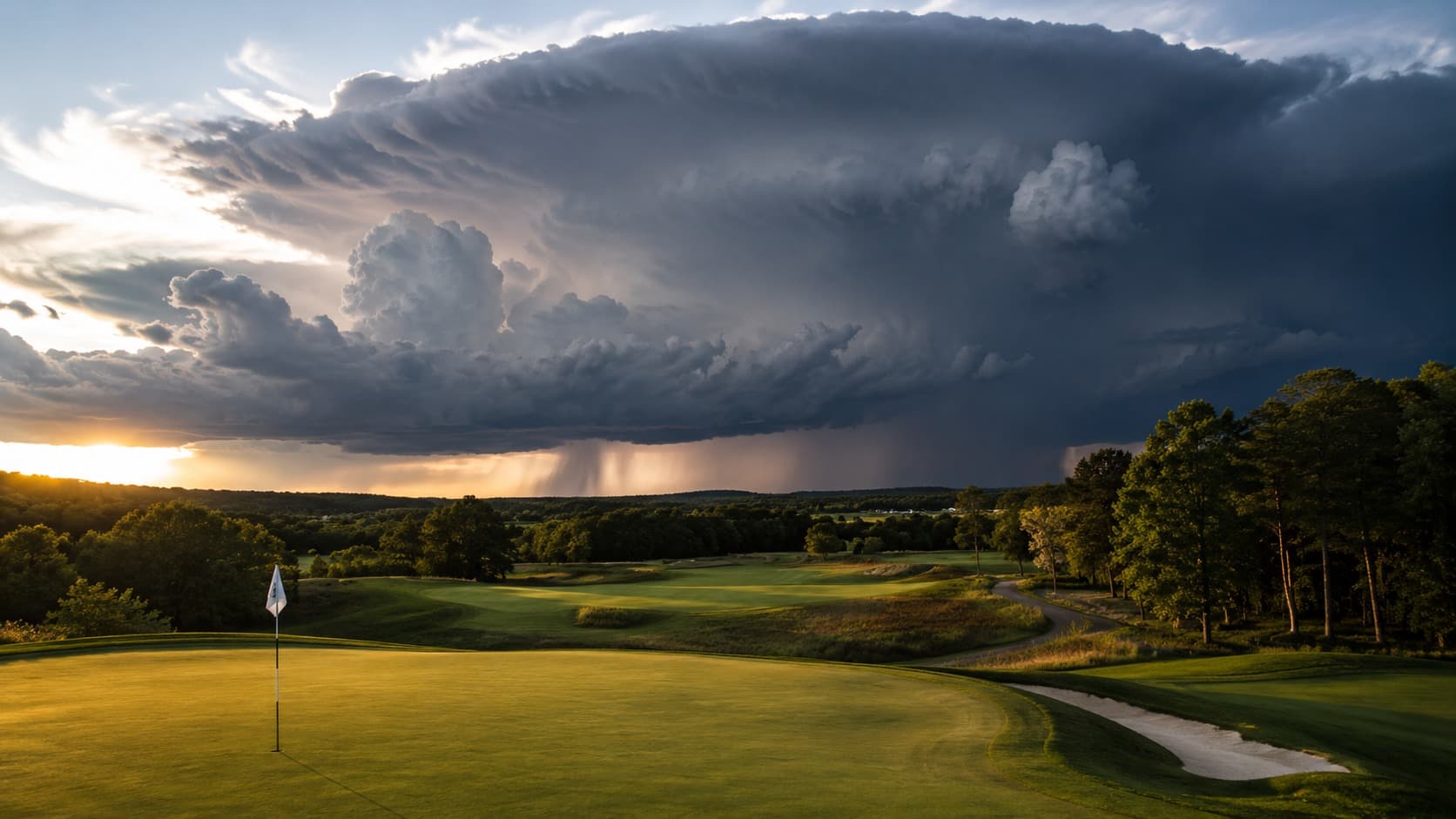
The Three O’Clock Storm: Reading Summer’s Convective Cycle to Protect Your Round
A 40% chance of afternoon thunderstorms does not mean a 40% chance of getting rained on. In the summer convective season it means the morning is nearly clear and the afternoon carries a fast-building, high-energy storm risk driven by a daily heating cycle. Here is the meteorology behind the pattern, the G-Score data on how the storm cycle punishes afternoon tee times across the Southeast, Midwest, and desert Southwest, the lightning-safety decision tree that actually matters, and the workflow that gets you off the course before the first bolt.
Read Story
How to Read a G-Score: The 0–100 Golf Playability Number, Decoded
A G-Score on this site is a single 0–100 number that tells you whether today is worth tee-up. Here is exactly what each band means, what drives the calculation, and how to use it to plan a round you will actually score on.
Read StoryDanorie
Editorial & Data
Golf Weather Score is built by Danorie. We compute the G-Score — our own playability rating — from live NOAA forecasts and published course scorecards, so any US course can be compared on any day with a single number. Methodology and data sources are documented on every page.
Every Friday Morning
When Celina Lynx Golf Club plays best next weekend.
Friday 6am ET: peak G-Score windows for Celina Lynx Golf Club, wind direction by hour, and one gear call. Three minutes to read, save you the round.
One email a week. Unsubscribe in one click.
The Caddie's Oracle
Draw your luck before the tee off