
Caddie's Gear Advisor
Curated for today's 46°F · Mist
Cold-Weather Performance Layers
Thermal mid-layers that move with your swing
Tour Hand Warmers
Rechargeable warmers trusted by caddies
Thermal Base Layers
Lightweight compression that traps heat
Winter Golf Headwear
Beanies and ear warmers built for the links
Glenmoor Country Club: Course Intelligence
Jack Nicklaus designed Glenmoor Country Club in 1996 on a piece of Canton, Ohio land in the northeast Ohio region west of Akron. The course was conceived as a private national club with hospitality emphasis — Glenmoor's brief from founder Bob Holmes was a Nicklaus-designed routing capable of hosting Champions Tour events without becoming a destination-resort property in the broader sense. The PGA Tour Champions Senior PGA Championship was played at Glenmoor in 1998 (Hale Irwin won), giving the club immediate Tour-rotation exposure within two years of opening.
The course plays around 7,084 yards par 72 from the championship markers, with bent fairways and a slope in the upper 130s. Nicklaus's signature throughout is the large, contoured green complexes and the strategic decisions that reward tee-ball positioning. The fifteenth hole is a 432-yard par-4 with a tee shot played over a natural creek; the seventeenth, a 215-yard par-3 across a natural pond, is the routing's most-discussed one-shotter. The eighteenth closes with a 462-yard par-4 with a green set against the clubhouse.
Glenmoor Country Club is private and access is members and accompanied guests only. The membership is regional Ohio business and professional families with multi-generation ties through the club's founding years. The Champions Tour hosting through the late 1990s was the primary modern tournament exposure, and the hospitality model includes lodging on the property for member-guest programming.
Northeast Ohio climate gives Glenmoor a playing season of April through October, with the firmest conditions in September and October. The course closes through brief winter cold snaps. The mature tree canopy through the property gives the routing a parkland character distinct from the more open Akron-area suburban courses, and the autumn color through October is part of the seasonal photographic signature.
Related Reading
Before you tee off at Glenmoor Country Club
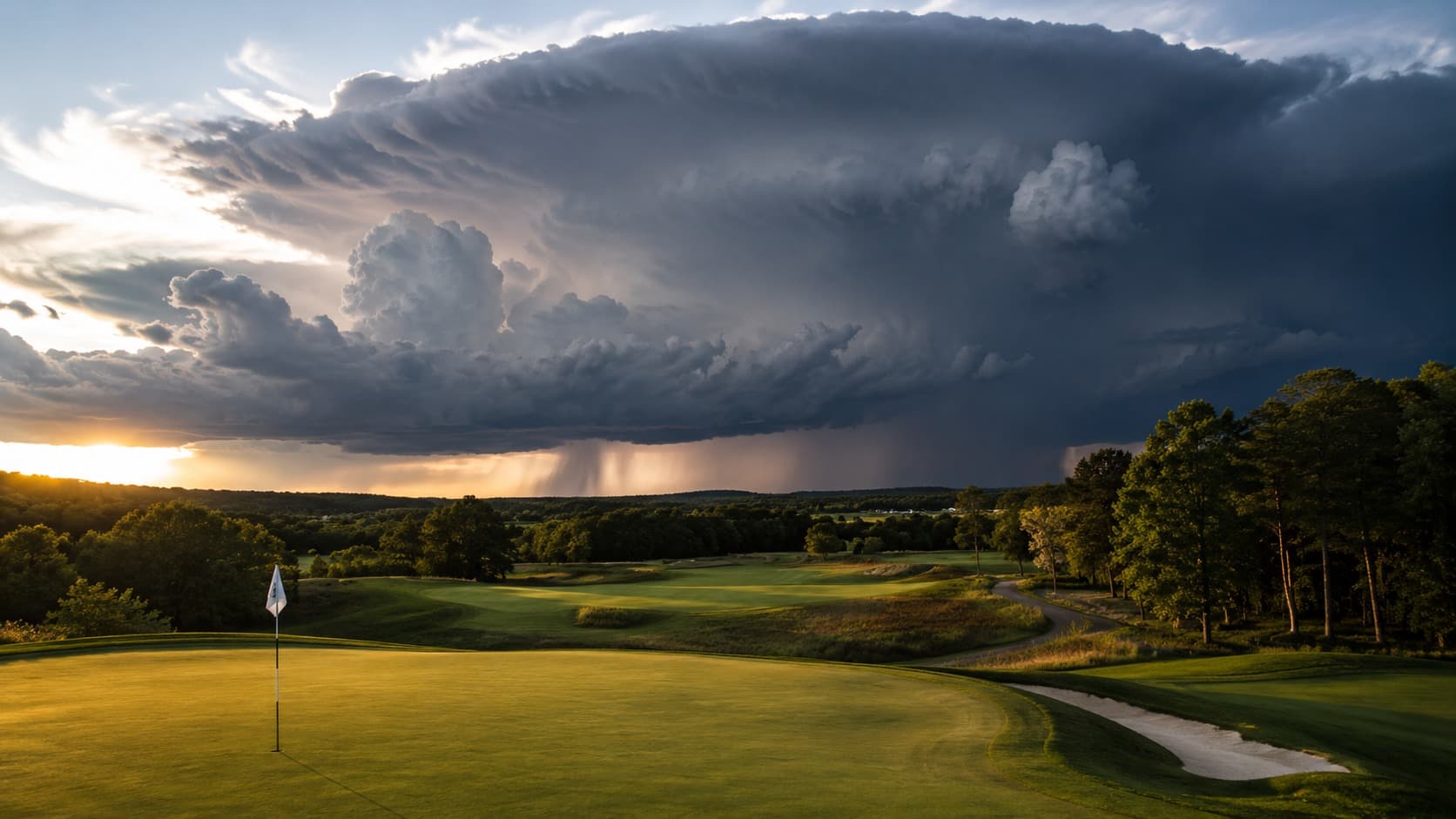
The Three O’Clock Storm: Reading Summer’s Convective Cycle to Protect Your Round
A 40% chance of afternoon thunderstorms does not mean a 40% chance of getting rained on. In the summer convective season it means the morning is nearly clear and the afternoon carries a fast-building, high-energy storm risk driven by a daily heating cycle. Here is the meteorology behind the pattern, the G-Score data on how the storm cycle punishes afternoon tee times across the Southeast, Midwest, and desert Southwest, the lightning-safety decision tree that actually matters, and the workflow that gets you off the course before the first bolt.
Read Story
How to Read a G-Score: The 0–100 Golf Playability Number, Decoded
A G-Score on this site is a single 0–100 number that tells you whether today is worth tee-up. Here is exactly what each band means, what drives the calculation, and how to use it to plan a round you will actually score on.
Read StoryDanorie
Editorial & Data
Golf Weather Score is built by Danorie. We compute the G-Score — our own playability rating — from live NOAA forecasts and published course scorecards, so any US course can be compared on any day with a single number. Methodology and data sources are documented on every page.
Every Friday Morning
When Glenmoor Country Club plays best next weekend.
Friday 6am ET: peak G-Score windows for Glenmoor Country Club, wind direction by hour, and one gear call. Three minutes to read, save you the round.
One email a week. Unsubscribe in one click.
The Caddie's Oracle
Draw your luck before the tee off