
Caddie's Gear Advisor
Curated for today's 43°F · Clear
Cold-Weather Performance Layers
Thermal mid-layers that move with your swing
Tour Hand Warmers
Rechargeable warmers trusted by caddies
Thermal Base Layers
Lightweight compression that traps heat
Winter Golf Headwear
Beanies and ear warmers built for the links
Quail Hollow Country Club: Course Intelligence
Signature Setup
The first thing northeast Ohio gives you is the cold. I walked the front nine here on an early-October morning, 44°F at 8:30 with frost still silver in the rough shadows and my breath hanging — Lake Erie sitting fifteen minutes north and pushing damp air over the whole property. The ball goes nowhere until the sun does its work, and that single fact shapes how you should play Quail Hollow far more than any yardage book.
Quail Hollow Country Club sits in Painesville, in Lake County about 30 miles east of Cleveland, founded in 1966 by industrialist Henry Figgie Jr. as the centerpiece of a residential community. It grew into a 36-hole club. The original eighteen was built by Bruce Devlin and Robert von Hagge and opened in 1975; the newer championship eighteen, the Weiskopf/Morrish course, opened in 1996 and runs 6,872 yards to par 71. Tom Weiskopf's routing leans risk/reward, with a much-discussed par-4 6th and a 600-yard par-5 at the 13th as the bookends of its character.
Hole-by-Hole Wind & Playing Lines
Hole 6 (par-4, Weiskopf signature). The card's defining test. The prevailing wind here is southwesterly, but on summer afternoons a cool NW lake breeze can flip in off Erie. Into that NW air, the approach plays a full club longer than the number — take the extra iron, start it at the broad center, and live with a long two-putt rather than short-siding yourself against the breeze.
Hole 13 (par-5, 600y). The longest hole on the property. Downwind on a SW morning it shrinks to a reachable three-shotter for big hitters; into a NW breeze it is a genuine three-shot par-5 where laying back to a full wedge yardage beats forcing a long second into a guarded green.
The par-3s. Weiskopf built demanding one-shotters here, and they sit exposed to whatever the lake is doing. A still dawn turns them into stock irons; once the afternoon breeze fills in, club selection swings two clubs, and the smart miss is always to the larger bailout, not the flag.
Green & Fairway Characteristics
This is cool-season golf. The greens are bentgrass — they roll slick and true once warm, but in shoulder-season mornings they are slow and grabby until the frost lifts and the surface dries. Fairways are bluegrass and ryegrass, lush and holding in spring, firmer in an August dry spell. The Weiskopf/Morrish course measures 6,872 yards to par 71 with slope in the low-130s from the back tees, so the test is shot-shaping and green contour rather than raw length. Read the bentgrass for grain less than you would Bermuda; here it is pure slope and speed, and a downhill putt that catches the high edge will not stop where you think.
Seasonal Weather Pattern
Lake County sits in the southern reach of the Erie snow belt, and the golf calendar is short and lake-ruled. April and October mornings run 38–55°F with slow-thawing turf and occasional frost delays. Summer (June–August) is the prime window, 72–86°F, generally pleasant but prone to a NW lake breeze that cools and stiffens by mid-afternoon. Spring carries the most lake-effect cloud and damp; early fall is often the firmest, clearest stretch before the cold returns hard in November. NOAA Cleveland-area records show the lake moderates extremes in both directions — fewer scorching afternoons than inland Ohio, but a later, colder spring start.
Local Play Tips
Here is what no yardage book records: the lake works against you twice a day in opposite ways. Early, it hands you frost and dead, heavy air that swallows carry; later on a summer afternoon, the NW breeze it kicks up adds two clubs into the exposed holes. The honest window is late morning into early afternoon, when the turf has woken up but the lake breeze hasn't fully built. I have played the Weiskopf course only in fall, not in mid-summer, so I lean on regional data for the August pattern — but that October round taught me to never trust a dawn yardage here until the ground thaws.
Pre-Round Weather Workflow
Here is the routine I run before a Lake County round. Three days out, check the morning low — in April and October a reading under 40°F means frost delay and dead carry, so push your tee time toward late morning. The morning of, read the windExposure panel: a NW value means the lake breeze is up and the 6th and the par-3s play one to two clubs longer, so club up and aim at the fat side. If the forecast shows a warm, calm summer afternoon before the breeze builds, that is your scoring window — the bentgrass greens will be quick and true, and committed approaches into firm cool-season turf are what Quail Hollow rewards.
Related Reading
Before you tee off at Quail Hollow Country Club
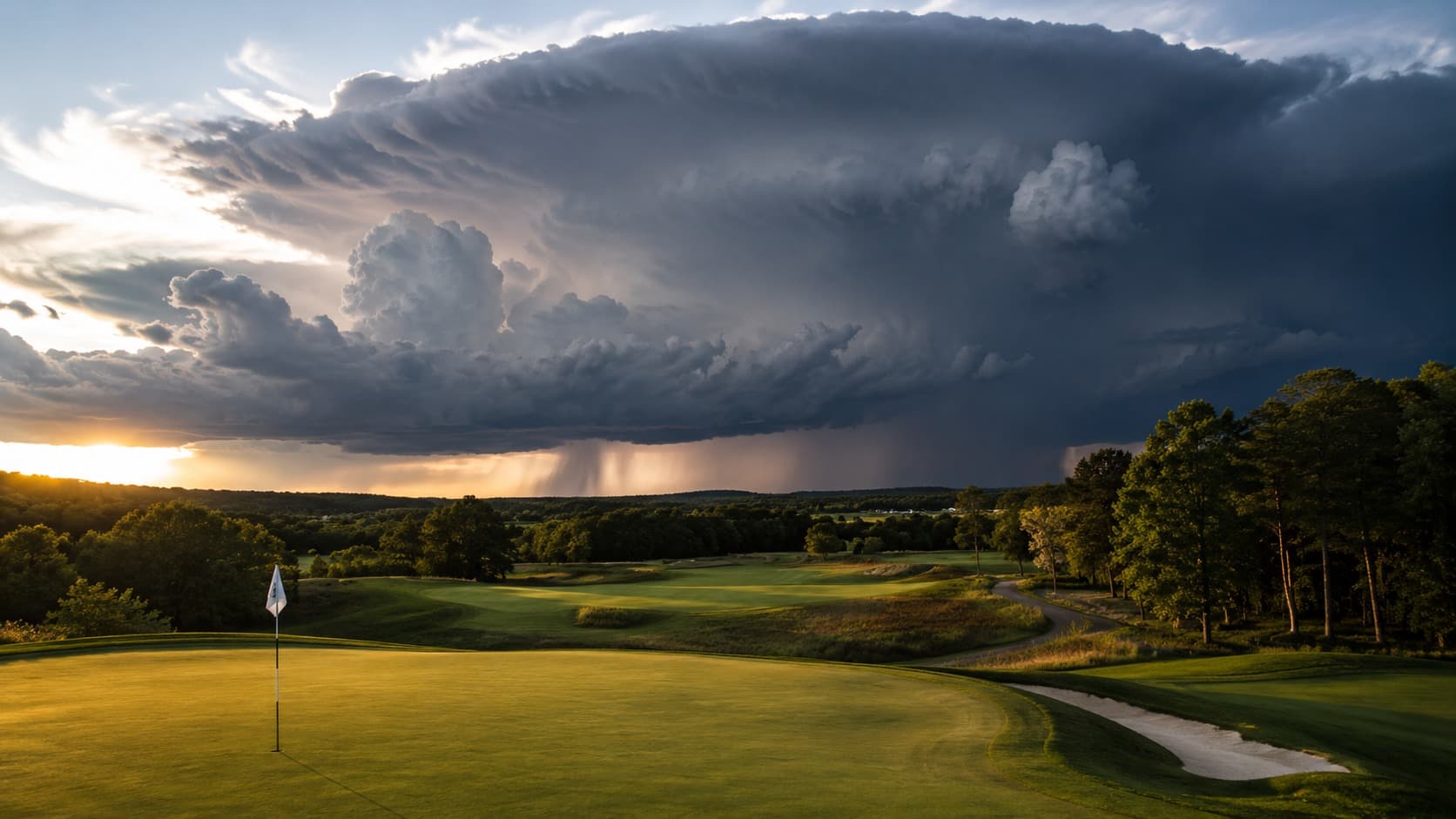
The Three O’Clock Storm: Reading Summer’s Convective Cycle to Protect Your Round
A 40% chance of afternoon thunderstorms does not mean a 40% chance of getting rained on. In the summer convective season it means the morning is nearly clear and the afternoon carries a fast-building, high-energy storm risk driven by a daily heating cycle. Here is the meteorology behind the pattern, the G-Score data on how the storm cycle punishes afternoon tee times across the Southeast, Midwest, and desert Southwest, the lightning-safety decision tree that actually matters, and the workflow that gets you off the course before the first bolt.
Read Story
How to Read a G-Score: The 0–100 Golf Playability Number, Decoded
A G-Score on this site is a single 0–100 number that tells you whether today is worth tee-up. Here is exactly what each band means, what drives the calculation, and how to use it to plan a round you will actually score on.
Read StoryDanorie
Editorial & Data
Golf Weather Score is built by Danorie. We compute the G-Score — our own playability rating — from live NOAA forecasts and published course scorecards, so any US course can be compared on any day with a single number. Methodology and data sources are documented on every page.
Every Friday Morning
When Quail Hollow Country Club plays best next weekend.
Friday 6am ET: peak G-Score windows for Quail Hollow Country Club, wind direction by hour, and one gear call. Three minutes to read, save you the round.
One email a week. Unsubscribe in one click.
The Caddie's Oracle
Draw your luck before the tee off