
Caddie's Gear Advisor
Curated for today's 77°F · Clear
Tour-Level Drivers
Engineered for maximum distance and forgiveness
Laser Rangefinders
Pin-seeking technology for precision approaches
Premium Golf Balls
Tour-caliber spin and distance performance
Performance Sunglasses
Polarized lenses optimized for reading greens
Your Golf Trip, Handled
The Ultimate Golf Trip Planner
Everything you need to play Valhalla Golf Club — from booking your flight to checking in course-side.
Course-Side Stays
Luxury hotels, resorts, and stay-and-play packages just minutes from the first tee.
Flights
Compare fares across 700+ airlines for the best route to your tee time.
SUV Rentals for Golf Bags
Spacious vehicles with room for clubs, bags, and your foursome.
Travel Insurance
Coverage for medical, weather delays, and gear at your destination.
Valhalla Golf Club: Course Intelligence
Signature Setup
I walked Valhalla on a championship week, a humid mid-May morning at 67°F with the Floyds Fork valley still holding overnight haze and the zoysia fairways heavy underfoot. The 18th stops you at the tee — the fairway splits in two, a low-left route and a high-right shelf, and the green sits in a natural bowl of rock and grandstand seating that funnels every roar back at you. I stood there picturing a second shot into that amphitheater and understood why this finishing hole has decided so many majors.
Jack Nicklaus routed Valhalla in 1986 on rolling ground southeast of Louisville, Kentucky, blending an open, links-like front nine with a wooded, elevation-changing back. It has hosted four PGA Championships — Mark Brooks in 1996, Tiger Woods over Bob May in a 2000 playoff, Rory McIlroy in 2014, and Xander Schauffele's record 21-under 263 in 2024 — plus the 2008 Ryder Cup, where the U.S. won 16½–11½. From the back tees it plays roughly 7,609 yards to a par of 71.
Hole-by-Hole Wind & Playing Lines
Hole 7, "Player's Choice" (#1 handicap, par-4, ~503y). A brute. Into the prevailing SSW summer wind it can demand driver plus a fairway wood to get home. The hole offers two fairways; the left is safer and longer, the right shorter but tighter against trouble. Take the left, accept 200+ in, and aim for the front third — a long-iron pin-high beats a forced shot that finds the greenside bunkering.
Hole 13 (par-5, island green). The famous one. The green sits on a rock-walled island reachable in two on a calm day, but a left-to-right afternoon wind pushes weak long shots into the water short-right. When the breeze is up, lay back to a full wedge — I'd rather have 95 in from dry grass than 40 from a downslope over rock.
Hole 18 (signature par-5, ~547y). Choose your fairway off the tee: low-left gives a flatter look, high-right shortens the carry but narrows the landing. Into a SSW wind the uphill second plays a club longer than the number, so favor the front of the amphitheater green and let the slope feed it back.
Green & Fairway Characteristics
The greens are bentgrass and run 12–13 on the Stimp for the PGA — firm, quick, and heavily contoured, with run-offs that reject anything not flighted to land soft. The fairways are zoysiagrass, which sits the ball up cleanly but grabs and holds rather than releasing, so you rarely get the long roll you'd find on a bentgrass or ryegrass cut. Water and rock-walled creek edges are in play on the back nine, and the closing stretch — the island-green 13th through the amphitheater 18th — is where leaderboards reshuffle. The 2024 PGA played soft and low-scoring, which tells you how the test changes the moment the zoysia and bentgrass hold moisture.
Seasonal Weather Pattern
Valhalla sits inland in north-central Kentucky, well away from any coastal moderation, so it runs a humid subtropical climate. Spring (April–May) is mild but storm-prone, 55–78°F — the 2024 PGA week saw thunderstorm delays and thick humidity. Summer (June–August) turns hot and sticky, often 84–92°F, with a SSW prevailing wind, heavy dew, and frequent afternoon thunderstorm risk that softens the zoysia. Autumn (late September–October) is the firm, calm sweet spot at 58–74°F. Winters close the course under frost and occasional snow, with January lows in the 20s–30s°F. NOAA's Louisville records show summer afternoon winds commonly in the 7–13 mph range out of the south-southwest.
Local Play Tips
Honest limitation first: Valhalla is a private club, so for most golfers realistic access is championship hospitality or an invited guest round — I've walked it, not logged member rounds, and I won't pretend to read these bentgrass greens like someone who plays them weekly. The thing the yardage book won't tell you: the zoysia fairways change the whole equation after rain. When they're wet you get almost no release, so the long par-4 7th and the par-5s stop being reachable. Time a dry, calm window and the course gives back two or three clubs of roll it hides on a humid afternoon.
Pre-Round Weather Workflow
Use the 7-day G-Score on this page the way I do. Three days out, check whether your tee window lands before or after the late-morning SSW breeze builds off the Floyds Fork valley — on a 7,609-yard par 71 with water on the back nine, that single factor moves the score 6–10 points. The morning of, read the windExposure panel: a S or SSW reading means the long 7th and the uphill 18th both play into the wind, so favor the safer fairway and club up one. If the temperature reads in the 60s°F with overnight rain — the classic spring-championship setup — expect the zoysia to hold and the bentgrass greens to stay receptive; take an extra club into every green and respect the fast, contoured putting surfaces, not your driver, as the part of the test that decides your round.
Related Reading
Before you tee off at Valhalla Golf Club

Best Golf Weather by State: Ranking America by Average G-Score
We ranked all 50 US states by average G-Score golf playability. California tops the list, but the results beyond the top five may surprise you.
Read Story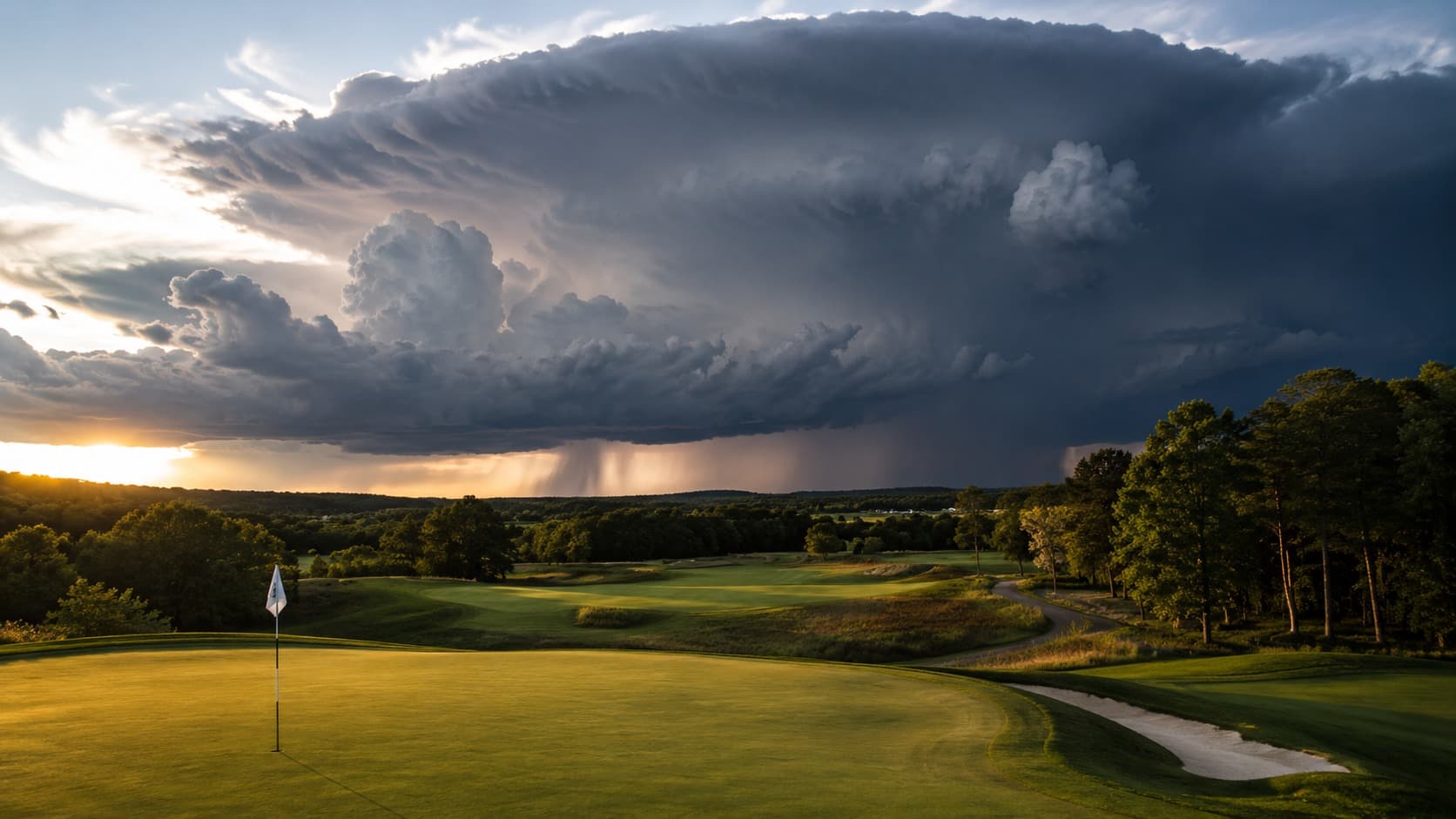
The Three O’Clock Storm: Reading Summer’s Convective Cycle to Protect Your Round
A 40% chance of afternoon thunderstorms does not mean a 40% chance of getting rained on. In the summer convective season it means the morning is nearly clear and the afternoon carries a fast-building, high-energy storm risk driven by a daily heating cycle. Here is the meteorology behind the pattern, the G-Score data on how the storm cycle punishes afternoon tee times across the Southeast, Midwest, and desert Southwest, the lightning-safety decision tree that actually matters, and the workflow that gets you off the course before the first bolt.
Read StoryDanorie
Editorial & Data
Golf Weather Score is built by Danorie. We compute the G-Score — our own playability rating — from live NOAA forecasts and published course scorecards, so any US course can be compared on any day with a single number. Methodology and data sources are documented on every page.
Every Friday Morning
When Valhalla Golf Club plays best next weekend.
Friday 6am ET: peak G-Score windows for Valhalla Golf Club, wind direction by hour, and one gear call. Three minutes to read, save you the round.
One email a week. Unsubscribe in one click.
The Caddie's Oracle
Draw your luck before the tee off