
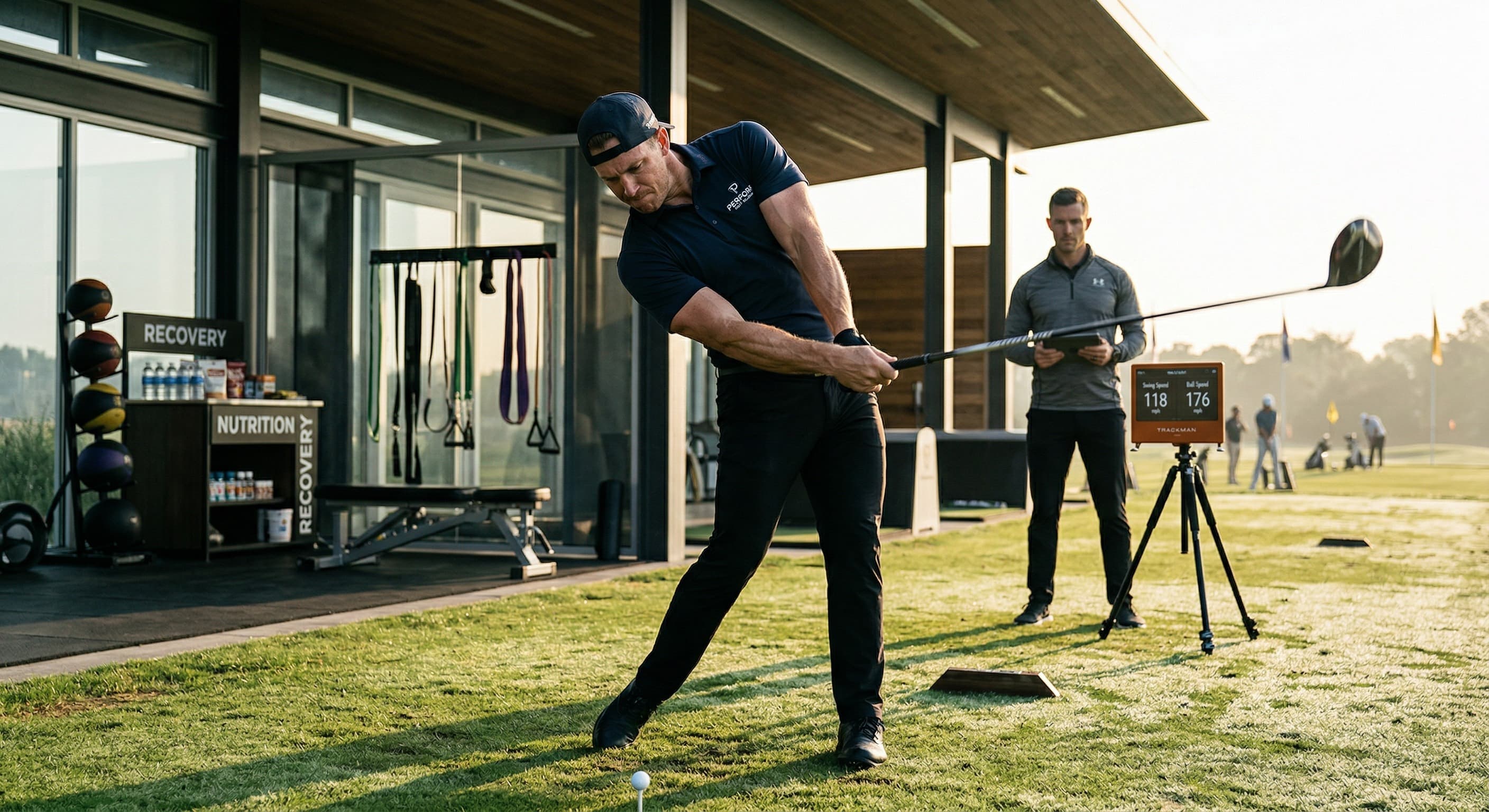
In the winter of 2019-2020, Bryson DeChambeau did something most touring professionals considered reckless. He gained over 40 pounds of muscle mass, overhauled his training regimen, and emerged on the PGA Tour swinging a driver at speeds previously reserved for long-drive competitors. His driving distance jumped from roughly 302 yards to 344 yards in a single off-season. He went on to win the 2020 U.S. Open at Winged Foot by six strokes, overpowering a course that had humbled the field for decades.
DeChambeau was not an anomaly. He was the most visible example of a trend that had been building for two decades. The average PGA Tour driving distance has climbed from 269.0 yards in 2003 to 299.2 yards in 2024, according to the PGA Tour's official ShotLink data. That is a gain of more than 30 yards in twenty years, and it is not primarily about equipment. It is about how players train, how they understand biomechanics, and how they fuel their bodies.
The science behind building swing speed is no longer reserved for tour players with six-figure training budgets. It is accessible, well-researched, and remarkably effective when applied correctly. This article breaks down exactly what that science says, who developed it, and how you can apply it to your own game.
The Kinetic Chain: Where Speed Actually Comes From
Every conversation about swing speed must begin with the kinetic chain. This concept, central to the work of the Titleist Performance Institute (TPI), describes how energy transfers through the body during the golf swing in a sequential, ground-up pattern.
Dr. Greg Rose and Dave Phillips, the co-founders of TPI, have spent over two decades studying how the body produces speed in golf. Their research, which has screened and analyzed over 30,000 golfers, identified a consistent pattern among the fastest and most efficient players in the world: energy moves from the ground through the legs, into the hips, through the torso, down the arms, into the hands, and finally into the club.
This is not a metaphor. It is measurable physics. Each segment of the body acts as a link in a chain, and each link must accelerate and then decelerate in the correct sequence to transfer maximum energy to the next segment.
Ground Reaction Forces
Speed begins at the ground. Research conducted using force plates at TPI and at the Titleist Performance Institute's biomechanics lab has shown that elite tour players generate between 150% and 200% of their body weight in vertical ground reaction force at impact. For a 180-pound player, that means they are pushing into the ground with 270 to 360 pounds of force.
This vertical force is critical because it allows the player to extend through impact, creating an upward thrust that accelerates hip rotation. Dr. Rose has described this as the 'vertical lift' component of the swing, and it is one of the clearest separators between tour players and amateurs. Most recreational golfers generate only 100-120% of body weight in vertical force, leaving significant speed on the table.
Lateral ground forces also play a role. During the transition from backswing to downswing, players shift pressure from the trail foot to the lead foot. Force plate data shows that elite players complete this pressure shift before the club reaches the halfway point of the downswing, giving them time to convert that lateral energy into rotational speed.
The X-Factor: Hip-Shoulder Separation
One of the most cited metrics in golf biomechanics is the X-factor, which measures the angular differential between the hips and shoulders at the top of the backswing. Research published by TPI and corroborated by studies at the University of Birmingham found that tour players typically achieve an X-factor of 45 to 55 degrees, while the average amateur golfer reaches only 25 to 35 degrees.
But the raw X-factor number is only part of the story. What matters even more is the X-factor stretch, a concept identified by biomechanist Dr. Phil Cheetham in his doctoral research. The X-factor stretch measures whether the hip-shoulder differential increases during the early downswing. In the fastest players, the hips begin rotating toward the target while the shoulders are still completing the backswing, momentarily increasing the separation. This elastic loading of the trunk muscles creates a stretch-shortening cycle that adds significant speed to the downswing.
Tour players who exhibit a large X-factor stretch gain an additional 10-15% of rotational speed compared to players whose shoulders and hips begin the downswing simultaneously.
The Kinematic Sequence
TPI's research identified the kinematic sequence as the signature of an efficient golf swing. Using 3D motion capture systems, Dr. Rose and his team measured the peak angular velocities of each body segment during the downswing. The data reveals a consistent pattern among elite players:
- Hips: peak angular velocity of 350-550 degrees per second
- Torso: peak angular velocity of 500-750 degrees per second
- Arms: peak angular velocity of 800-1,200 degrees per second
- Club: peak angular velocity of 1,800-2,200 degrees per second
Each segment reaches its peak speed after the previous segment has begun to decelerate. This deceleration is not a loss of energy. It is a transfer. When the hips decelerate, they transfer their rotational energy to the torso. When the torso decelerates, it transfers energy to the arms. And when the arms decelerate near impact, the club whips through at maximum speed.
This is the same principle behind cracking a whip. Each segment is progressively smaller and lighter, so the same amount of energy produces progressively higher speed. When any segment fires out of order, or when a segment fails to decelerate properly, speed leaks out of the system. This is why many strong athletes who take up golf cannot hit the ball as far as smaller, more coordinated players. Raw strength means nothing if the sequence is broken.
Speed Training Protocols That Actually Work
Understanding the kinetic chain is essential, but knowledge alone does not produce speed. You need specific training protocols designed to increase the velocity at which your neuromuscular system can move the club. Over the past decade, several evidence-based speed training systems have emerged, each with documented results.
SuperSpeed Golf System
The SuperSpeed Golf system is one of the most widely adopted overspeed training tools in golf. It consists of three weighted clubs: one lighter than a standard driver (approximately 20% lighter), one at roughly driver weight, and one heavier than a standard driver (approximately 5% heavier). The protocol involves swinging the light club first to establish a higher neurological speed ceiling, then progressively moving to heavier implements.
The principle is called overspeed training, and it is rooted in neuroscience. When you swing a lighter implement at maximum effort, your nervous system learns to fire motor units faster than it would with a standard-weight club. Over time, this higher firing rate carries over to your normal driver swing.
SuperSpeed's own data, collected from over 100,000 users, shows that the average golfer gains 5-8% in clubhead speed within the first 6-8 weeks of consistent training. For a golfer swinging at 95 mph, that represents a gain of 5-8 mph, which translates to approximately 12-20 additional yards of carry distance.
The Stack System
Developed by Dr. Sasho MacKenzie, a biomechanics professor at St. Francis Xavier University in Nova Scotia, Canada, The Stack System takes a more individualized approach to speed training. Dr. MacKenzie's research focused on optimizing the relationship between club mass, swing speed, and the golfer's physical capabilities.
The Stack uses a single handle with interchangeable weights that allow the golfer to create multiple club configurations ranging from very light to very heavy. The training protocol is delivered through an app that adapts to each golfer's baseline speed and progress. Sessions are typically 10-15 minutes long and are performed 3-4 times per week.
Dr. MacKenzie's published research shows that the optimal overspeed stimulus involves swinging an implement that is 20% lighter than the golfer's standard club at maximum effort. The heavy club work (using loads 20-50% heavier than standard) develops the strength and stability needed to support the higher speeds.
Independent testing has shown gains of 5-8 mph for amateur golfers over 8-12 weeks. Professional golfers, who are already closer to their neurological ceiling, typically gain 2-4 mph.
Rypstick
The Rypstick takes a different approach by using resistance rather than weight variation. It provides real-time feedback through an integrated sensor and app, measuring clubhead speed on every swing. The resistance-based design forces the golfer to generate more force throughout the swing arc, developing both speed and the ability to maintain that speed under load.
Tour Player Examples
Phil Mickelson is perhaps the most compelling case study for speed training in older golfers. As he entered his late 40s and early 50s, Mickelson committed to an aggressive speed training program that included overspeed work, strength training, and dietary changes. The result was that he maintained and even slightly increased his driving distance at an age when most golfers are losing 1-2 mph per year. At 50, he won the 2021 PGA Championship at Kiawah Island, becoming the oldest major champion in history, averaging over 300 yards off the tee that week.
Bryson DeChambeau's transformation remains the gold standard. His ball speed increased from approximately 175 mph to over 190 mph during his transformation period, and he has recorded ball speeds above 200 mph in long-drive competition. His clubhead speed went from roughly 118 mph to over 135 mph with his driver. This was not achieved through speed training alone but through a comprehensive program that included heavy strength training, overspeed work, biomechanical optimization, and significant nutritional changes.
Strength Training for Golf: Building the Engine
Speed training tools address the neurological side of the equation, but without a strong physical foundation, speed gains will plateau quickly. The body must be capable of producing and absorbing high forces at high speeds without breaking down.
The Key Movement Patterns
Golf-specific strength training should be organized around the movement patterns that drive the swing. These are not bodybuilding exercises performed in the hope that general strength will somehow transfer to golf. They are targeted movements selected because research has demonstrated their correlation with swing speed.
Hip Hinge (Deadlift variations): The ability to generate force through hip extension is fundamental to the golf swing. Research by Keogh et al. (2009), published in the Journal of Strength and Conditioning Research, found that squat and deadlift one-rep max (1RM) values were significantly correlated with driving distance in competitive golfers. Players who could deadlift 1.5 times their body weight or more drove the ball an average of 15-20 yards farther than those who could not.
Rotational Power (Medicine Ball Throws): TPI research has demonstrated that rotational medicine ball throw distance has a correlation coefficient of r = 0.82 with clubhead speed. This is one of the strongest predictive relationships in golf fitness research. The rotational med ball scoop toss and shotput throw are the two most commonly used variations because they closely mimic the rotational and lateral force patterns of the golf swing.
Single-Leg Stability: Golf is played on one leg. At impact, the lead leg must stabilize the entire body while the trunk rotates at over 500 degrees per second. Single-leg exercises like Bulgarian split squats, single-leg Romanian deadlifts, and lateral lunges develop the stability and strength needed to maintain posture and control during the swing.
Dr. Stuart McGill's Big 3 for Core Stability
Dr. Stuart McGill, professor emeritus of spine biomechanics at the University of Waterloo, has been one of the most influential researchers in understanding how the core functions during athletic movement. His work is particularly relevant to golfers because the golf swing places significant rotational and compressive loads on the lumbar spine.
Dr. McGill's research identified three exercises that build core endurance and stability while minimizing spinal stress. These are known as the 'Big 3':
- Modified Curl-Up: One leg bent, one straight. Hands under the lumbar spine. Lift the head and shoulders slightly without flexing the lumbar spine. Hold for 10 seconds. This develops anterior core endurance without the spinal flexion loading that sit-ups create.
- Side Plank: Support the body on the elbow and feet (or knees for beginners). Hold a straight line from head to feet. This develops lateral core stability, which is essential for resisting the lateral shear forces generated during the downswing.
- Bird Dog: From a hands-and-knees position, extend the opposite arm and leg while maintaining a neutral spine. This trains the posterior chain and anti-rotation stability simultaneously.
Dr. McGill recommends performing these exercises daily as a foundation, using a descending rep scheme (e.g., 3 sets of 10-second holds, then 8, then 6) to build endurance without fatigue-induced form breakdown. For golfers, this trio builds the spinal stability needed to support high-speed rotation without the back pain that plagues so many players.
A Sample Weekly Training Program
For an amateur golfer committed to building speed, a well-structured week might look like this:
Monday: Strength Session A (Lower Body Emphasis)
- Trap bar deadlift: 4 sets of 5 reps at 80-85% 1RM
- Bulgarian split squat: 3 sets of 8 per leg
- Hip thrust: 3 sets of 10
- Pallof press (anti-rotation): 3 sets of 12 per side
- McGill Big 3: 3 rounds
Tuesday: Speed Training Session
- Dynamic warmup: 10 minutes
- Overspeed protocol (SuperSpeed, Stack, or similar): 24-36 max-effort swings following the manufacturer protocol
- Radar-measured driver swings: 10-15 swings with speed feedback
Wednesday: Strength Session B (Upper Body and Rotational Power)
- Rotational medicine ball scoop toss: 4 sets of 5 per side (max effort)
- Med ball shotput throw: 3 sets of 5 per side
- Dumbbell bench press: 3 sets of 8
- Single-arm cable row: 3 sets of 10 per side
- Lateral band walks: 3 sets of 12 per side
Thursday: Speed Training Session
- Same protocol as Tuesday, varied stick weights or Stack configurations
Friday: Strength Session C (Full Body Power)
- Squat jumps or box jumps: 4 sets of 4
- Kettlebell swing: 4 sets of 8
- Single-leg Romanian deadlift: 3 sets of 8 per leg
- Cable woodchop: 3 sets of 10 per side
- Farmer carry: 3 sets of 40 yards
Saturday: Mobility and Active Recovery
- Thoracic spine rotation drills: 3 sets of 10 per side
- 90/90 hip switches: 3 sets of 8 per side
- Yoga-based flow: 20-30 minutes focusing on hip openers and thoracic mobility
- Foam rolling: 10-15 minutes
Sunday: Play or Rest
Flexibility and Mobility: Unlocking the Range You Need
Strength and speed training will hit a ceiling if the body cannot move through the ranges of motion required for an efficient golf swing. Mobility is not about being a contortionist. It is about having enough range in the right joints to allow the kinetic chain to function properly.
The TPI Screen
The TPI physical screen is a 16-point movement assessment that evaluates a golfer's ability to perform the movements required for an efficient swing. Developed by Dr. Greg Rose and his team, the screen has been administered to over 30,000 golfers and has identified clear correlations between specific movement limitations and common swing faults.
The screen evaluates overhead deep squat depth, single-leg balance, toe touch flexibility, pelvic rotation, torso rotation, wrist hinge, forearm rotation, and several other movement patterns. Based on the results, a TPI-certified professional can identify exactly which physical limitations are contributing to swing faults and speed loss.
Critical Mobility Benchmarks
TPI research has identified specific mobility benchmarks that correlate with efficient, high-speed swings:
- Thoracic Spine Rotation: Golfers need at least 45 degrees of rotation in each direction. Limited thoracic rotation forces the lumbar spine to compensate, leading to both speed loss and back pain. Most desk-bound amateurs have only 25-35 degrees.
- Hip Internal Rotation: At least 40 degrees of internal rotation is needed in each hip. The lead hip requires internal rotation during the downswing to allow proper clearing and rotation. Limited hip internal rotation is one of the most common causes of early extension, which TPI identifies as one of the most prevalent swing faults among amateur golfers. Early extension causes the pelvis to thrust toward the ball during the downswing, disrupting posture and costing significant speed.
- Shoulder Flexibility: Adequate shoulder flexion (180 degrees) and external rotation (90 degrees) are needed for a full backswing without compensatory movements in the spine or wrists.
Yoga and Golf
Yoga has become increasingly popular among tour players, and for good reason. The practice addresses many of the mobility limitations that constrain swing speed. Key yoga poses for golfers include:
- Pigeon pose and 90/90 stretch: Open the hips and address internal and external rotation limitations
- Thread the needle and open book: Improve thoracic spine rotation
- Downward dog to low lunge flow: Address hamstring flexibility and hip flexor tightness simultaneously
- Supine spinal twist: Improve trunk rotation and reduce lower back tension
Dynamic Warmup Protocol
A proper dynamic warmup before play or practice takes just 10 minutes and has been shown to increase clubhead speed by 2-4 mph compared to starting cold. Here is a research-backed sequence:
- Arm circles and shoulder rotations: 30 seconds each direction
- Trunk rotations with a club across the shoulders: 20 reps
- Hip circles: 10 per direction per leg
- Walking lunges with rotation: 8 per side
- Lateral lunges: 8 per side
- Practice swings at 50%, 75%, and 100% effort: 5 swings at each level
This sequence progressively increases tissue temperature, activates the neuromuscular system, and rehearses the movement patterns needed for the swing. Skipping it is one of the most common mistakes amateur golfers make, particularly in cold weather.
Nutrition for Speed and Recovery
Most golfers think of nutrition in terms of what to eat on the course. That matters, but if your goal is to build swing speed over weeks and months of training, nutrition plays a far larger role. It determines how well you recover from training, how much muscle you can build, and how effectively your nervous system functions during max-effort speed work.
Protein for Muscle Recovery and Growth
Speed training and strength training create micro-damage in muscle tissue. Protein provides the amino acids needed to repair and strengthen that tissue. Current sports nutrition research recommends 1.6 to 2.2 grams of protein per kilogram of body weight per day for athletes engaged in strength and power training. For a 180-pound (82 kg) golfer, that translates to 131 to 180 grams of protein daily.
Timing matters as well. Research published in the Journal of the International Society of Sports Nutrition suggests distributing protein intake across 4-5 meals throughout the day, with 25-40 grams per meal, to optimize muscle protein synthesis.
Creatine Monohydrate
Creatine monohydrate is one of the most thoroughly researched supplements in sports science. A meta-analysis by Rawson and Volek (2003), published in the Journal of Strength and Conditioning Research, found that creatine supplementation improved power output by 5-10% across a range of high-intensity activities.
For golfers, this is significant. Creatine increases the availability of phosphocreatine in muscle tissue, which is the primary fuel source for explosive, short-duration efforts like the golf swing. The recommended dose is 3-5 grams daily, taken consistently. There is no need for a loading phase, though some protocols use 20g per day for 5-7 days to saturate stores faster.
Creatine is legal, safe for long-term use, and has no banned substance concerns for competitive golfers. It also supports cognitive function, which is relevant for the mental demands of tournament golf.
Hydration and Power Output
Dehydration is one of the most underestimated performance killers in golf. Research has consistently shown that even 2% dehydration (losing about 3 pounds of water weight for a 180-pound golfer) can reduce power output by 10-20% and impair coordination, reaction time, and decision-making.
During a four-hour round, a golfer can lose 2-4 pounds of fluid through sweat, especially in warm conditions. This makes proactive hydration essential. The general guideline is to drink 16-20 ounces of water in the two hours before a round, then 4-8 ounces every 15-20 minutes during play. Adding electrolytes (sodium, potassium, magnesium) helps maintain fluid balance, particularly in heat or humidity.
Pre-Round and On-Course Fueling
The brain and muscles both rely on glucose for high-intensity output. Running low on fuel during a round leads to declining clubhead speed, especially on the back nine.
Pre-round: Eat a meal containing complex carbohydrates and moderate protein 2-3 hours before your tee time. Examples include oatmeal with eggs, a turkey sandwich on whole grain bread, or rice with chicken and vegetables. Avoid high-fat or high-fiber meals that slow digestion.
On-course: Aim for 150-200 calories per 9 holes to maintain blood sugar and energy levels. Good options include bananas, trail mix, protein bars, or a peanut butter sandwich. Avoid sugary snacks that cause rapid blood sugar spikes followed by crashes.
Sleep: The Ultimate Recovery Tool
Sleep is where the body consolidates the physical and neurological adaptations from training. Research from Stanford University's sleep center found that athletes who extended their sleep to 7-9 hours per night showed measurable improvements in reaction time, sprint speed, and overall physical performance.
For golfers, sleep is also when motor learning consolidation occurs. The movement patterns practiced during speed training and swing work are encoded into long-term motor memory during deep sleep stages. Chronic sleep deprivation (less than 6 hours per night) has been shown to impair motor learning by up to 40%.
Practical sleep hygiene recommendations include maintaining a consistent bedtime, keeping the bedroom cool (65-68 degrees Fahrenheit), limiting screen exposure in the hour before bed, and avoiding caffeine after 2 PM.
Cold Weather and Speed Loss
Temperature has a direct and measurable effect on swing speed and ball flight. Golfers who play in cold conditions need to understand these effects and plan accordingly.
Muscle Contraction Speed in Cold
Muscle contraction velocity decreases when tissue temperature drops. Research in exercise physiology has shown that muscle power output can decline by 10-15% when ambient temperature drops from 75 degrees Fahrenheit to 50 degrees Fahrenheit, assuming the golfer does not adequately warm up. This is because cold muscles contract more slowly, tendons become less elastic, and nerve conduction velocity decreases.
For a golfer who swings at 100 mph in warm conditions, this can mean a drop to 85-90 mph in cold weather without a proper warmup. That translates to 20-30 yards of lost distance.
The G-Score and Temperature
The GolfWeatherScore.com G-Score factors in temperature's impact on performance, helping golfers understand how weather conditions will affect their game before they reach the course. The 'Feels Like' temperature reading, which accounts for wind chill and humidity, is a more accurate predictor of performance impact than raw temperature alone.
When the 'Feels Like' temperature drops below 55 degrees Fahrenheit, golfers should expect measurable speed loss and plan their club selection accordingly. The G-Score clothing recommendation system helps golfers layer properly to maintain core body temperature without restricting the range of motion needed for a full swing.
Cold Weather Warmup Protocol
In cold conditions, the dynamic warmup protocol described earlier becomes even more critical. Golfers should extend the warmup to 15 minutes and add the following:
- Light jogging or jumping jacks for 2-3 minutes to raise core temperature
- Extra emphasis on thoracic rotation drills
- More gradual progression from 25% effort swings up to full speed
- Hand warmers in pockets between shots to maintain grip sensitivity
The 8-Week Amateur Speed Building Plan
Here is a practical, progressive plan for an amateur golfer looking to gain 5-8 mph of clubhead speed over two months. This plan assumes the golfer has a baseline level of fitness and no significant injury history.
Weeks 1-2: Foundation Phase
- Strength: 3 sessions per week. Focus on movement quality. Trap bar deadlift (3x8), goblet squat (3x10), single-leg RDL (3x8/side), push-ups (3x12), Pallof press (3x10/side). Moderate loads, perfect form.
- Speed: No dedicated speed training yet. Take baseline speed measurements with a radar device.
- Mobility: Daily 10-minute routine targeting thoracic spine, hips, and shoulders.
- Nutrition: Establish protein target (1.6-2.2g/kg/day). Begin creatine supplementation (3-5g/day). Optimize hydration habits.
Weeks 3-4: Introduction Phase
- Strength: 3 sessions per week. Increase loads by 5-10%. Add rotational medicine ball throws (3x5/side) and box jumps (3x4).
- Speed: 2 sessions per week. Begin overspeed protocol with light club or stack system. 24 max-effort swings per session. Track speeds.
- Mobility: Continue daily routine. Add 90/90 hip switches and yoga hip openers.
- Nutrition: Ensure pre-training meals are fueling sessions properly. Monitor sleep quality.
Weeks 5-6: Loading Phase
- Strength: 3 sessions per week. Working loads at 80-85% 1RM for main lifts. Deadlift (4x5), squat (4x5), med ball throws increasing to 4x5/side with heavier ball.
- Speed: 2 sessions per week. Full overspeed protocol including light, medium, and heavy implements. 30-36 swings per session. Begin tracking weekly averages, not just peak speeds.
- Mobility: Continue daily work. Test progress against TPI benchmarks (45 degrees thoracic rotation, 40 degrees hip IR).
- Nutrition: Maintain all protocols. Add post-training recovery meal within 60 minutes of training.
Weeks 7-8: Realization Phase
- Strength: 2 sessions per week. Reduce volume (3x3-5 on main lifts) but maintain or slightly increase intensity. Focus on power movements: med ball throws, jump variations, kettlebell swings.
- Speed: 3 sessions per week. Peak overspeed training frequency. 36 max-effort swings per session. Test for speed gains at end of week 8.
- Mobility: Continue daily routine. Focus on maintaining gains.
- Nutrition: Ensure sleep is prioritized (7-9 hours). Hydration and protein intake remain consistent.
Expected Results: The average amateur golfer following this program consistently should see a gain of 5-8 mph in clubhead speed, translating to approximately 12-20 yards of additional carry distance. Some golfers will see more, particularly those who were significantly under-trained at baseline. The key is consistency. Missing sessions erratically will undermine neurological adaptation, which requires repeated high-quality stimulus to take hold.
Measuring Progress and Avoiding Common Mistakes
If you are investing time and energy into building swing speed, you need to measure it objectively. Perception is unreliable. A swing that feels fast may not be, and a swing that feels smooth may actually be your fastest.
Invest in a personal launch monitor or radar device. Products like the PRGR launch monitor, Swing Caddie, or the more advanced FlightScope Mevo and Trackman units provide the data you need. Track the following metrics weekly:
- Clubhead speed: Your primary target metric
- Ball speed: Should increase proportionally with clubhead speed
- Smash factor: Should remain at 1.44-1.50 with a driver. If smash factor drops as speed increases, you are losing strike quality
- Dispersion: Speed gains are worthless if accuracy deteriorates significantly
Common mistakes to avoid during a speed building program include:
- Training every day: The nervous system needs recovery. More is not better.
- Ignoring technique: Speed training should complement technical work, not replace it.
- Skipping strength work: Overspeed tools alone will plateau without a foundation of physical strength.
- Neglecting sleep and nutrition: These are not optional supplements to training. They are essential components.
- Chasing peak speed over average speed: One swing at 110 mph is less useful than consistently swinging at 105 mph. Focus on raising your floor, not just your ceiling.
The Modern Path to Distance
Building swing speed is no longer a mystery reserved for tour players and their performance teams. The science is clear, the protocols are proven, and the tools are accessible. What was once the domain of biomechanics labs and elite training facilities is now available to any committed amateur.
The path forward requires understanding the kinetic chain and how your body creates speed. It requires targeted strength training that builds the engine. It requires dedicated speed training protocols that teach your nervous system to fire faster. It requires mobility work that ensures you can access the range of motion you need. And it requires nutrition and recovery habits that allow your body to adapt and grow.
Bryson DeChambeau did not gain 40 yards by swinging harder. He gained them by training smarter, eating better, and understanding the biomechanics of speed at a level most golfers never explore. You do not need to gain 40 pounds or swing at 135 mph. But the same principles that drove his transformation can drive yours.
Five to eight miles per hour of clubhead speed is within reach for almost any amateur golfer willing to commit 8-12 weeks to a structured program. That is 12-20 yards of additional distance. That is a shorter iron into every green. That is a competitive advantage that compounds over every round you play.
The science is there. The question is whether you are willing to do the work.