
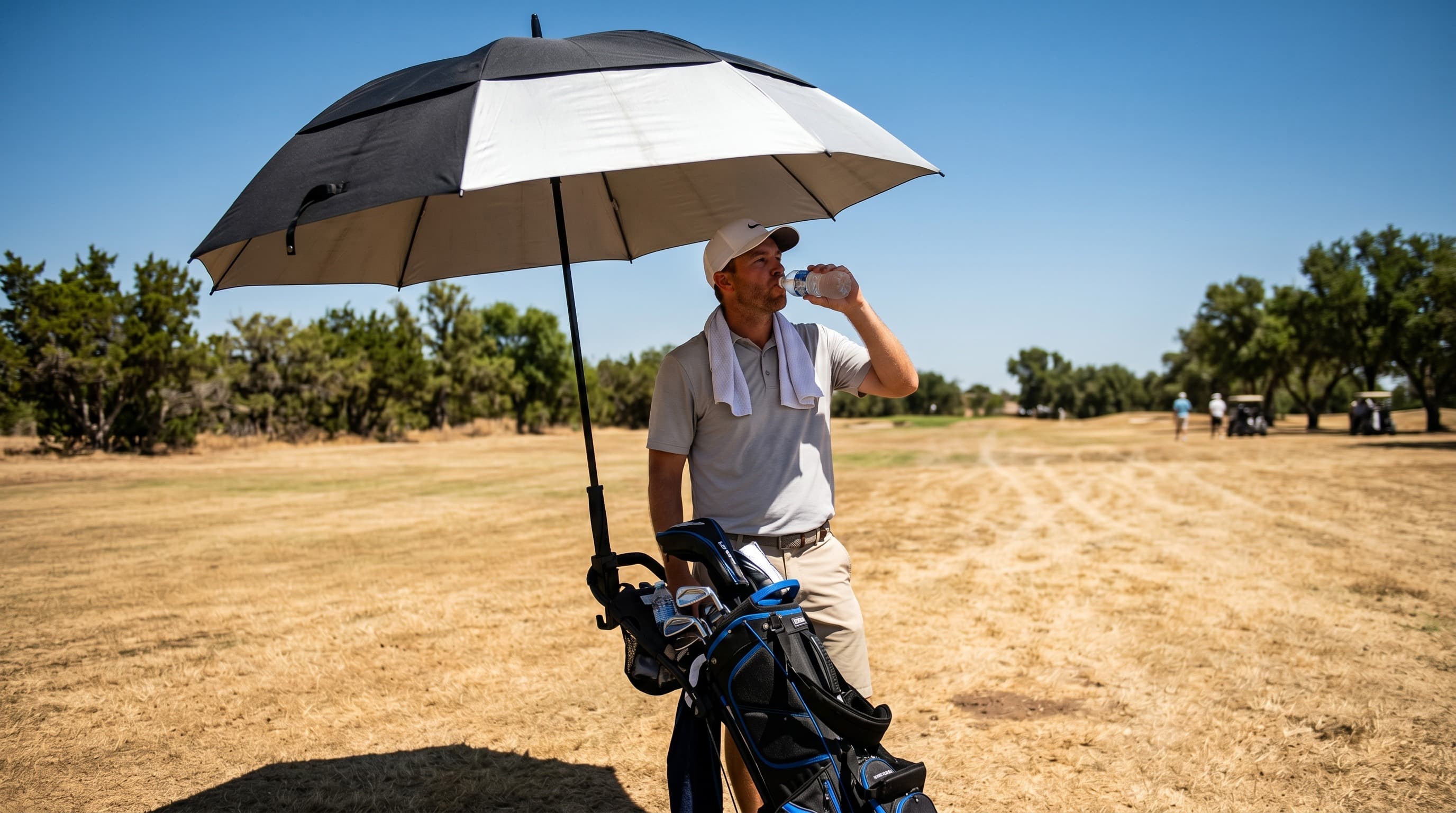
Summer golf is a negotiation between ambition and thermodynamics. You want to play. The course is open. The days are long. But when the temperature climbs past 90 degrees and the humidity makes the air feel like a wet blanket, your body and your game start paying a tax that most golfers drastically underestimate.
Heat does not just make you uncomfortable. It measurably degrades your physical performance, your cognitive function, and your equipment behavior. Studies on athletic performance in heat consistently show that decision-making accuracy drops by 15 to 20 percent when core body temperature rises above normal. Grip strength decreases as hands sweat. Muscle endurance fades faster. And the ball itself behaves differently in hot, dense summer air.
This guide is not about avoiding summer golf. It is about playing it intelligently. With the right preparation, hydration strategy, and course management adjustments, you can play competitive golf in conditions that send unprepared golfers to the clubhouse by the 12th hole.
What Heat Does to Your Body on the Golf Course
A round of golf takes four to five hours. During that time, you are exposed to direct sunlight, walking several miles, and generating heat through physical exertion. In summer conditions, this creates a physiological cascade that affects your game long before you feel obviously overheated.
The Dehydration Timeline
Dehydration begins before you feel thirsty. By the time your brain registers thirst, you have already lost approximately 1 to 2 percent of your body weight in fluid. At this level, research shows measurable declines in concentration, reaction time, and fine motor control, exactly the skills you need for putting and short game precision.
At 3 percent dehydration, typically reached by the 10th to 12th hole in extreme heat without proper hydration, muscle cramps become likely, decision fatigue accelerates, and your ability to judge distances deteriorates. Many golfers report that their worst holes in summer rounds cluster in this mid-to-late round window, and dehydration is a primary culprit.
At 4 percent or above, heat exhaustion becomes a genuine medical risk. Symptoms include dizziness, nausea, excessive fatigue, and confusion. Golf is a uniquely dangerous sport for heat illness because the slow pace of play extends exposure time and the social pressure to continue playing can override warning signals.
Cognitive Decline in Heat
Golf is as much a mental game as a physical one, and heat attacks the mental side ruthlessly. Research published in the Journal of Applied Physiology found that cognitive task performance, including spatial reasoning, working memory, and risk assessment, declines significantly when ambient temperature exceeds 90 degrees Fahrenheit.
On the golf course, this translates to poor club selection, aggressive decisions that you would not make in comfortable conditions, and reduced ability to read greens accurately. The most insidious part is that heat-impaired decision-making often feels normal in the moment. You do not realize you are making worse choices until you look at your scorecard afterward.
Grip and Swing Changes
Sweaty hands are more than an annoyance. When your grip becomes slick with perspiration, your hands instinctively tighten to maintain control. This increased grip pressure reduces wrist hinge, decreases clubhead speed, and promotes a more rigid, arms-dominated swing. The result is shorter distances, less feel, and a tendency toward pushed or blocked shots.
Additionally, hot muscles are looser and more flexible, which sounds like an advantage but can actually increase swing variability. The extra range of motion in your hips and shoulders may cause overrotation or inconsistent positions at the top of the backswing if you are not consciously managing your tempo.
Hydration Strategy: Before, During, and After
Proper hydration for summer golf does not start at the first tee. It starts the night before.
Pre-Round Hydration (12 Hours Before)
The evening before a hot round, drink 16 to 24 ounces of water with dinner. Avoid excessive alcohol, which is a diuretic that accelerates fluid loss. In the morning, drink another 16 ounces of water at least one hour before your tee time. This gives your body time to absorb the fluid and process any excess before you start playing.
Adding an electrolyte tablet or powder to your morning water is highly beneficial. Electrolytes, particularly sodium, potassium, and magnesium, help your body retain fluid rather than simply passing it through. Plain water without electrolytes is absorbed less efficiently and does not replace the minerals lost through sweat.
During the Round
The goal during the round is to drink before you are thirsty. A practical schedule is 4 to 6 ounces of fluid every two holes, which works out to roughly one standard water bottle every four to five holes. For an 18-hole round in extreme heat, plan to consume 64 to 80 ounces of fluid total.
Alternate between water and an electrolyte drink. Pure water is fine for mild heat, but once temperatures exceed 85 degrees and you are sweating heavily, electrolyte replacement becomes critical. Sports drinks, electrolyte tablets, or even a pinch of salt in your water bottle all help maintain the mineral balance that keeps your muscles functioning and your brain sharp.
Avoid energy drinks and excessive caffeine during hot rounds. Caffeine is a mild diuretic and a stimulant that can increase heart rate in already stressful heat conditions. If you need a caffeine boost, limit it to one small coffee before the round and switch to water and electrolytes once you start playing.
Post-Round Recovery
Rehydration after a hot round takes longer than most golfers realize. Plan to drink 20 to 24 ounces of fluid for every pound of body weight lost during the round. If you do not weigh yourself before and after, a good rule of thumb is to drink steadily for two to three hours after finishing, aiming for at least 32 ounces of electrolyte-enriched fluid.
Eating a meal with sodium helps retention. The classic post-round burger is actually decent for rehydration because it provides sodium, protein, and fluids from accompanying drinks. Just make sure you are drinking water alongside whatever else you consume.
UV Protection: More Than Sunscreen
Skin cancer is the most common cancer in the United States, and golfers are among the most UV-exposed recreational athletes because of the extended time spent outdoors. A four-hour round in summer delivers more UV exposure than most people receive in an entire week of normal activity.
Sunscreen Protocol
Apply broad-spectrum SPF 50 or higher sunscreen 20 to 30 minutes before your tee time. This gives the active ingredients time to bind to your skin and become effective. Reapply every two hours, which means at least once during the round, typically around the turn.
Pay attention to commonly missed areas: the tops of ears, the back of the neck, the backs of hands, and exposed calves if wearing shorts. These areas receive heavy UV exposure during golf and are frequently where skin cancers develop in avid golfers.
Clothing Choices
Modern UPF-rated golf apparel provides better protection than sunscreen alone. A UPF 50 shirt blocks 98 percent of UV radiation, does not wash off with sweat, and does not need reapplication. Light-colored, moisture-wicking fabrics with UPF rating are the optimal choice for summer rounds.
A wide-brimmed hat provides significantly more protection than a standard golf cap. The traditional baseball-style cap leaves ears, neck, and the sides of the face exposed. Bucket hats or wide-brimmed styles popular among Australian and Asian tour players provide full coverage while remaining functional for the golf swing.
Sunglasses
Quality polarized sunglasses protect your eyes from UV damage and reduce glare that can interfere with reading greens. Many golfers avoid sunglasses because of concern about depth perception, but modern golf-specific lenses are designed to enhance contrast and depth perception rather than diminish it. Look for lenses that enhance green and brown tones, which improves your ability to read subtle breaks on putting surfaces.
Course Management in Extreme Heat
Smart course management in summer heat is about energy conservation and risk reduction. Your goal is to minimize the damage from inevitable physical and mental fatigue.
Tee Time Strategy
The single most impactful decision for summer golf is when you play. Early morning tee times starting at dawn offer the coolest temperatures, softest greens, and most comfortable conditions. The tradeoff is dew on the greens and potentially less wind.
Late afternoon tee times, starting at 3 to 4 PM, are the second-best option. While temperatures may still be warm, the declining sun angle reduces UV intensity and the late afternoon often brings cooling breezes. You also benefit from playing fewer holes in peak heat.
Mid-day tee times between 11 AM and 2 PM should be avoided when possible in extreme heat. This is the window of maximum UV exposure, highest temperatures, and greatest physiological stress. If mid-day is your only option, commit to aggressive hydration and be willing to pace yourself.
The G-Score system helps with this decision. Check the hourly breakdown for your course and compare morning versus afternoon G-Scores. In summer, morning scores are often 15 to 20 points higher than afternoon scores, reflecting the dramatic difference in playing conditions.
Pace and Energy Management
Walk in the shade whenever possible, even if it means a slightly longer path between shots. Use a pushcart instead of carrying your bag; carrying a 25-pound bag increases metabolic heat generation by 15 to 20 percent compared to using a cart. If riding in a golf cart, park in the shade rather than full sun when waiting for your shot.
Use every available moment to cool down. Stand under trees during waits. Place a cold, wet towel on the back of your neck between shots. Many golfers bring a small cooler with ice and damp towels specifically for this purpose. The neck is a key cooling point because blood vessels run close to the surface, and cooling this area helps reduce core body temperature.
Playing Strategy Adjustments
In extreme heat, your body is already fighting a battle against the environment. Do not compound that stress with aggressive course management. Consider these adjustments.
Club up on every approach. Heat-fatigued muscles produce slightly less speed, and tired decision-making tends to underestimate distances. Adding half a club to your approaches accounts for both the physical and mental effects of heat.
Accept the middle of the green. On approach shots, aim for the center of the green rather than attacking pins. This conservative strategy reduces the risk of short-siding yourself, which requires high-energy recovery shots, and keeps you in two-putt range where you can save energy.
Simplify off the tee. Choose the club and target that requires the least mental energy. If driver into a narrow fairway requires intense focus and perfect execution, consider a three-wood to a wider landing area. Conserving mental energy early in the round pays dividends on the back nine when heat fatigue peaks.
Take your time with putts. Heat degrades green-reading accuracy, so compensate by being more deliberate. Take an extra few seconds to confirm your read. Walk around the putt if you usually only look from one angle. The small investment of time improves accuracy when your brain is running hot.
Equipment Considerations for Summer Golf
Grips
Your grips are the only contact point between your body and the club, and in summer heat they become a critical performance variable. Cord grips or multi-textured grips provide better traction in sweaty conditions than smooth rubber grips. If your grips are more than a year old, consider re-gripping before summer season. Worn grips compound the slipperiness problem that heat creates.
Keep a dry towel clipped to your bag and wipe your grips between shots. Some golfers carry grip-specific drying powder or rosin that absorbs moisture from the grip surface. A glove specifically designed for hot weather, typically thinner with perforated ventilation, helps maintain feel without trapping heat.
Ball Selection
Golf ball compression changes with temperature. In summer heat, the ball compresses more easily on impact, which can increase spin rates and reduce distance slightly with high-swing-speed players. For most amateurs, the effect is minor, but if you notice your driver distance dropping in extreme heat, a firmer ball may help maintain your normal distances.
Additionally, balls left in a hot car or direct sun can temporarily become softer and more reactive. Store your balls in the shade or inside a climate-controlled space when not in use.
Cart and Bag Setup
Stock your bag for heat management. Essential summer additions include an insulated water bottle holder or clip, a cooling towel, extra sunscreen, an emergency electrolyte packet, and a wide-brimmed hat as a backup. If you walk, an umbrella mounted on your pushcart provides portable shade that makes a measurable difference in body temperature between shots.
Recognizing Heat Illness: When to Stop
Knowing when to quit is as important as knowing how to play in heat. Golf culture sometimes rewards toughness and finishing the round regardless of conditions, but heat illness is a medical emergency that demands respect.
Warning signs to watch for: Excessive sweating that suddenly stops is a sign your body's cooling system is failing. A headache that intensifies despite hydration suggests heat exhaustion. Dizziness, confusion, or difficulty concentrating beyond normal fatigue means your core temperature is dangerously elevated. Nausea or vomiting requires immediate withdrawal from play and cooling.
What to do: Move to shade immediately. Apply cold water or ice to the neck, wrists, and forehead. Drink cool fluids with electrolytes. Do not resume play until symptoms fully resolve, which may take 30 minutes to an hour. If symptoms persist or worsen, seek medical attention.
No round of golf is worth a heat stroke. The course will be there tomorrow. Check the G-Score, plan for better conditions, and play when the weather works with you rather than against you.
Conclusion: Play Smart, Play Long
Summer golf is not about surviving. It is about adapting. The golfers who post their best summer scores are not necessarily the fittest or the toughest. They are the ones who hydrate proactively, protect themselves from UV damage, manage their energy across 18 holes, and adjust their strategy to account for what heat does to their body and their game.
The tools are simple: water, electrolytes, sunscreen, shade, and the awareness to use them consistently rather than sporadically. The G-Score makes the tee time decision easier by quantifying exactly how playable conditions are at different hours. And the willingness to play conservatively when your body is stressed turns a potentially miserable round into a smart, enjoyable one.
Summer is the longest golf season in most of the country. Play it wisely, and you will play more of it. That is the real win.