
Caddie's Gear Advisor
Curated for today's 77°F · Clear
Tour-Level Drivers
Engineered for maximum distance and forgiveness
Laser Rangefinders
Pin-seeking technology for precision approaches
Premium Golf Balls
Tour-caliber spin and distance performance
Performance Sunglasses
Polarized lenses optimized for reading greens
Your Golf Trip, Handled
The Ultimate Golf Trip Planner
Everything you need to play Arizona Country Club — from booking your flight to checking in course-side.
Best time to golf in ArizonaCourse-Side Stays
Luxury hotels, resorts, and stay-and-play packages just minutes from the first tee.
Flights
Compare fares across 700+ airlines for the best route to your tee time.
SUV Rentals for Golf Bags
Spacious vehicles with room for clubs, bags, and your foursome.
Travel Insurance
Coverage for medical, weather delays, and gear at your destination.
Arizona Country Club: Course Intelligence
Signature Setup
There is a moment on the 18th at Arizona Country Club when you look up and Camelback Mountain fills the whole sky behind the green. I played here on a January morning, 49°F at 8 a.m. with frost burning off the rough, and the cold air took a good ten yards off my drives until the sun cleared the ridge.
This is one of metro Phoenix's older private clubs, rooted in the Arcadia district east of downtown. The course traces to a William P. Bell routing that opened in 1946, and in its early decades it served as a Phoenix Open host during the tournament's formative years. It is a classic parkland layout — tree-lined, walkable, par 72 around the 6,400-yard mark from the regular tees — rather than a modern target-desert design. I came to it as a member's guest, not a tournament player, so I'll speak to how it plays for a single-digit visitor and leave the trophy history to the club's own record.
Hole-by-Hole Wind & Playing Lines
The valley wind here follows a clock more than a compass. Dawn is still; a thermal off the desert floor fills in from the southwest through late morning, often 12–18 mph by early afternoon.
- The #1-handicap par-4: uphill and long, it stretches further into that afternoon thermal. My 8 a.m. approach was a clean 6-iron; by the time we turned for home around noon a playing partner was hitting 4-iron to the identical pin. Aim right-center off the tee — the breeze drifts the ball toward the tree line on the left.
- The 18th closer toward Camelback: the rising ground and the mountain backdrop trick the eye into under-clubbing. Take what the yardage says plus the slope, and trust the extra club into the hill.
- A short par-3 across the interior: a stock wedge at sunrise, but once the southwest flow is up the wind quarters left-to-right and the green sheds anything hit thin. Club up and play to the fat of the surface.
Green & Fairway Characteristics
The greens are mid-sized and subtly tilted, and the dominant break runs off the higher Arcadia ground rather than toward the mountain your eye keeps drifting to. I misread my first two putts as uphill and both ran past — read the regional slope, not the local one. Surfaces roll around 10.5 on the Stimp for ordinary member play, a touch quicker in spring once the overseed firms up.
The turf is the standard two-season Phoenix program: warm-weather Bermuda through summer, overseeded with ryegrass for the green winter months when rates and play peak. Fairways are parkland-soft in the cool season and run noticeably faster as the surface dries from May onward. Slope sits in the mid-120s, so position off the tee — keeping below the hole and out of the mature eucalyptus — matters more than raw distance.
Seasonal Weather Pattern
Arcadia sits at roughly 1,200 ft, and Phoenix is among the most rain-reliable golf markets in the country. Winter highs (Dec–Feb) settle near 66–70°F with a low chance of rain, and mornings can start in the mid-40s — cold enough to cost you a club until midday. October and March are the sweet spot: warm afternoons, calm dawns.
Summer is the dividing line. June through August highs run 105–115°F, and the July–September monsoon brings abrupt late-day thunderstorms, gusty outflow, and blowing dust. I haven't played Arizona Country Club in the depth of July, so I won't guess how the greens hold under that heat — but the operating rule is plain: in summer, only the first two daylight hours are genuinely playable.
Local Play Tips
The decisive local factor is Camelback's shadow line. At sunrise the mountain shades the eastern holes, so the closing stretch stays a few degrees cooler and the air stays calmer there longer than on the exposed front. If you can choose, warm up early and get the back nine done before the thermal fills in. Carry water and drink it before the turn — in this valley, waiting until the 10th is already a hole too late. And respect the frost-delay window in deep winter; an 8 a.m. tee can sit until the rough thaws.
Pre-Round Weather Workflow
Use the 7-day G-Score and windExposure panel the night before:
- G-Score 80+ with a morning slot: the green light — soft surfaces, still air, go at the flags.
- Read the wind clock: if the forecast ramps the southwest flow past 12 mph by midday, add a club on every uphill and back-nine approach and favor the side away from the trees.
- Summer (May–Sept): treat any tee time after 9 a.m. as a heat round — lighten the bag, double the fluids, and expect the G-Score to fall through the afternoon.
- Monsoon months: track the afternoon storm probability; a calm dawn here can turn to dust and lightning by 4 p.m.
Related Reading
Before you tee off at Arizona Country Club
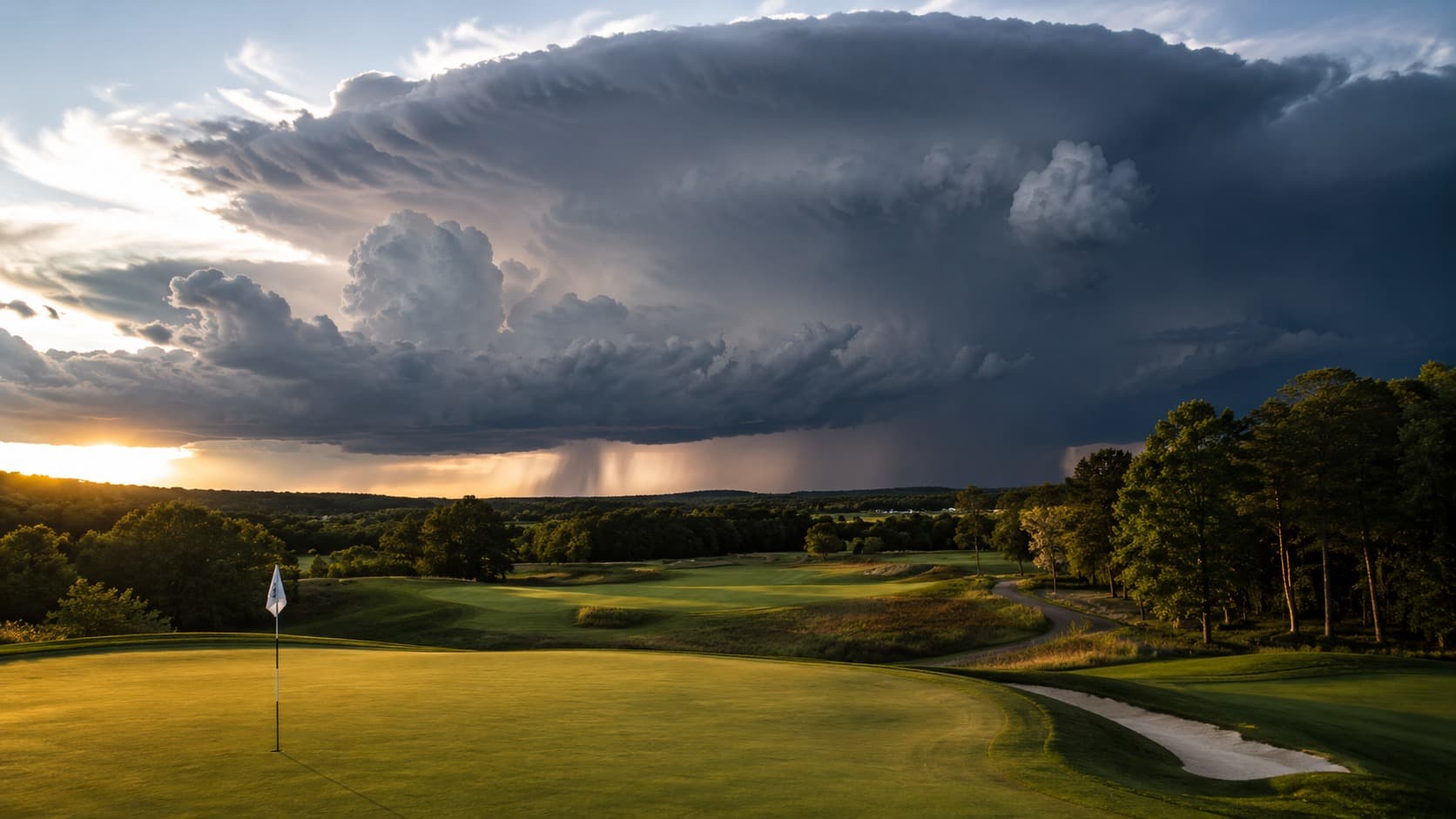
The Three O’Clock Storm: Reading Summer’s Convective Cycle to Protect Your Round
A 40% chance of afternoon thunderstorms does not mean a 40% chance of getting rained on. In the summer convective season it means the morning is nearly clear and the afternoon carries a fast-building, high-energy storm risk driven by a daily heating cycle. Here is the meteorology behind the pattern, the G-Score data on how the storm cycle punishes afternoon tee times across the Southeast, Midwest, and desert Southwest, the lightning-safety decision tree that actually matters, and the workflow that gets you off the course before the first bolt.
Read Story
How to Read a G-Score: The 0–100 Golf Playability Number, Decoded
A G-Score on this site is a single 0–100 number that tells you whether today is worth tee-up. Here is exactly what each band means, what drives the calculation, and how to use it to plan a round you will actually score on.
Read StoryDanorie
Editorial & Data
Golf Weather Score is built by Danorie. We compute the G-Score — our own playability rating — from NOAA forecasts and published course scorecards, so any US course can be compared on any day with a single number. Methodology and data sources are documented on every page.
Every Friday Morning
When Arizona Country Club plays best next weekend.
Friday 6am ET: peak G-Score windows for Arizona Country Club, wind direction by hour, and one gear call. Three minutes to read, save you the round.
One email a week. Unsubscribe in one click.
The Caddie's Oracle
Draw your luck before the tee off