
Caddie's Gear Advisor
Curated for today's 48°F · Clear
Cold-Weather Performance Layers
Thermal mid-layers that move with your swing
Tour Hand Warmers
Rechargeable warmers trusted by caddies
Thermal Base Layers
Lightweight compression that traps heat
Winter Golf Headwear
Beanies and ear warmers built for the links
Carthage Golf Club: Course Intelligence
Signature Setup
Carthage Golf Club is a 9-hole course in Carthage, Illinois, out on County Road 1830 in Hancock County, west-central Illinois near the Mississippi and the Great River Road. The card is short and honest: 2,805 yards from the back tees, par 35, course rating 33.5. Sources disagree on its age — some list the course as built around 1930, others as opening for play in 1940 — and I haven't found a recorded architect, so I won't attach a famous name to it. What the layout gives you is a compact prairie nine with real variety: a 120-yard par-3 over water at the 2nd, a long 520-yard par-5 at the 5th, and dogleg shaping at the 4th and 8th. I haven't teed it up at Carthage myself, so the playing notes below lean on the published scorecard and on what open, exposed west-central Illinois golf consistently does to a round.
Hole-by-Hole Wind & Playing Lines
The defining feature here is exposure. This is farmland golf — flat-to-rolling, few trees deep in the corridors — so wind is the main defense on a course that can't defend with length. The 2nd, a 120-yard par-3 over water, is the hole the wind decides: dead calm it's a smooth wedge, but on a crossing south breeze the carry math changes and bailing long-and-dry beats flirting with the water short. The 5th at 520 yards is the number-one strategic test. Into the prevailing SW summer flow it stretches to a genuine three-shotter; the mistake is forcing a hero second into the wind and leaving an awkward 60-yard pitch. I'd lay the second back to a full wedge distance instead — on exposed holes like this I plan backward from a yardage I can hit cleanly rather than chasing the green into a headwind. The doglegs at 4 and 8 reward shaping with the wind: a left-to-right hole into a left-to-right breeze plays a club longer than the card, so take the extra stick rather than over-cutting it.
Green & Fairway Characteristics
The greens are bentgrass and the fairways are the cool-season fescue/bluegrass mix typical of Illinois municipal courses, which means conditions swing hard by season. In the cool, wet shoulder months bent holds approaches softly; through a hot, dry July–August stretch the surfaces firm up and release, so plan to land short and let it run. At 2,805 yards over nine, scoring is about wedges and the flat stick, not driver — the par is 35, so there's one fewer par-5 than a standard nine, and the 520-yard 5th is where you make or lose your number. Greens on a course of this rating (33.5) are modest in slope; the read that matters more is grain and firmness in summer, not severe contour.
Seasonal Weather Pattern
West-central Illinois is humid continental, and the playing calendar is shaped by it. Spring (April–May) is the windiest stretch — gusty SW–S flow over open ground, cold-morning starts in the 40s that knock 5–8 yards off carry until the air warms. Summer (June–August) runs hot and sticky, daytime highs commonly in the upper 80s with the south wind building through the morning and afternoon thunderstorm cells popping after midday; the dew-soft early tee times play very differently from a 2 p.m. round on firm, fast bent. Fall (September–October) is the prize window: stable air, lighter wind, cooler greens that hold. Winter effectively closes seasonal play in this part of the state.
Local Play Tips
One thing the tee-time apps won't tell you: on a fully exposed Hancock County nine like this, your tee time is a wind decision more than a daylight one. The south breeze that's calm at 7 a.m. is often a steady two-club factor on the 520-yard 5th by 10 a.m., so an early slot doesn't just beat the heat — it beats the wind that defends the course's only real length. Second, because the age and design history aren't well documented, don't expect the polished signage or yardage-book detail of a destination course; walk the 2nd and 5th on arrival if you can, since those two holes (the water carry and the long par-5) will set your whole scorecard. When I scout a short, exposed muni like this, I budget my round around the one long hole and the one forced carry rather than the total yardage.
Pre-Round Weather Workflow
Use the 7-day G-Score on this course page to pick your tee time, and run two checks. First, wind: a south or southwest reading above ~12 mph means the 520-yard 5th and the doglegs at 4 and 8 all play a club or more longer — club up and favor the safe side. Second, the morning-vs-afternoon split in summer: dew-soft bent greens hold approaches far better before the surfaces bake, and afternoon storm probability climbs after midday June–August, so take the earliest slot when convective risk is up. The windExposure flag here trends high because there's no tree cover to break the prairie breeze; a dawn G-Score will typically run several points better than the same afternoon. Bottom line at Carthage: the right tee time, ahead of the south wind, is worth more strokes than any club in the bag.
Related Reading
Before you tee off at Carthage Golf Club
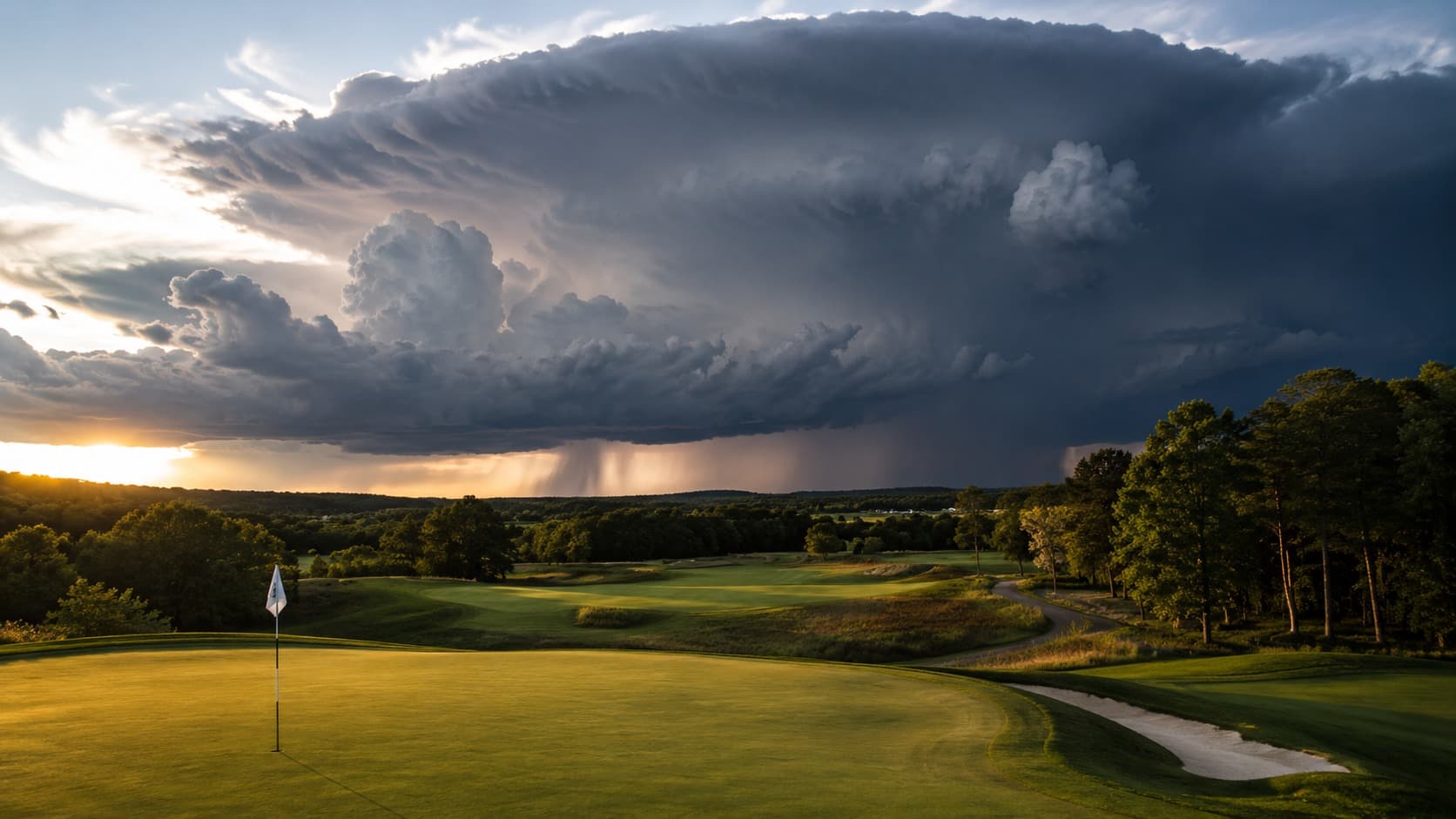
The Three O’Clock Storm: Reading Summer’s Convective Cycle to Protect Your Round
A 40% chance of afternoon thunderstorms does not mean a 40% chance of getting rained on. In the summer convective season it means the morning is nearly clear and the afternoon carries a fast-building, high-energy storm risk driven by a daily heating cycle. Here is the meteorology behind the pattern, the G-Score data on how the storm cycle punishes afternoon tee times across the Southeast, Midwest, and desert Southwest, the lightning-safety decision tree that actually matters, and the workflow that gets you off the course before the first bolt.
Read Story
How to Read a G-Score: The 0–100 Golf Playability Number, Decoded
A G-Score on this site is a single 0–100 number that tells you whether today is worth tee-up. Here is exactly what each band means, what drives the calculation, and how to use it to plan a round you will actually score on.
Read StoryDanorie
Editorial & Data
Golf Weather Score is built by Danorie. We compute the G-Score — our own playability rating — from NOAA forecasts and published course scorecards, so any US course can be compared on any day with a single number. Methodology and data sources are documented on every page.
Every Friday Morning
When Carthage Golf Club plays best next weekend.
Friday 6am ET: peak G-Score windows for Carthage Golf Club, wind direction by hour, and one gear call. Three minutes to read, save you the round.
One email a week. Unsubscribe in one click.
The Caddie's Oracle
Draw your luck before the tee off